Date: June 20, 2025
Categories: Indian versus Dutch Work Ethic
Key words
Work culture, Cultural differences, Dutch workplace, Indian workplace
Hofstede dimensions, Monochronic vs. polychronic time, Intercultural communication, Intercultural onboarding, Organizational adaptation, Cultural sensitivity
Excerpt
The cultural differences between Dutch and Indian workplaces within a large Dutch grocery chain are examined in this case study. It illustrates how vary-ing viewpoints on hierarchy, communication, motivation, and time manage-ment impact teamwork using Edward T. Hall’s time orientation theory and Hofstede’s cultural dimensions. The study reveals real-life workplace issues through an interview with an Indian employee and offers workable solutions, like intercultural onboarding and feedback mechanisms, to promote inclusiv-ity and understanding in heterogeneous teams.
Overview
The following case study investigates the differences in the work culture perspectives within one of the biggest supermarket franchises in The Netherlands, that also operates internationally. Additionally, the impact of cultural differences in productivity levels, decision-making, communication and workplace dy-namics in the company will be discussed.
In order to thoroughly analyze said disparities, the Hofstede Model will be utilized as the main framework for comparing the differences between Indian and Dutch culture. More specifically, the cultural dimen-sions of Power Distance, Individualism, Motivation towards Achievement and Success, and Indulgence in business settings are focused on as they reflect the biggest distinctions in the cultural characteristics. Furthermore, Edward T. Hall’s concept of monochronic and polychronic time perceptions is employed to further analyze the theories developed.
For this essay, an interview with a colleague from the Finance team of the franchise mentioned previ-ously, was completed. This interview also provided the authors with a guideline of the main work culture perspectives differences observed between the Indian culture of the interviewed and the Dutch com-pany culture of the supermarket chain. The findings illustrate the contrast in approaches to deadlines and task prioritization, high context and low context communication strategies between employees and the necessity to conform to the company’s national culture, so as to adapt to the workplace.
Lastly, the case explores potential solutions to aid multi-culture companies in creating a diverse and inclusive work setting.
Hofstede Dimensions
Cultural Comparison Between India and The Netherlands
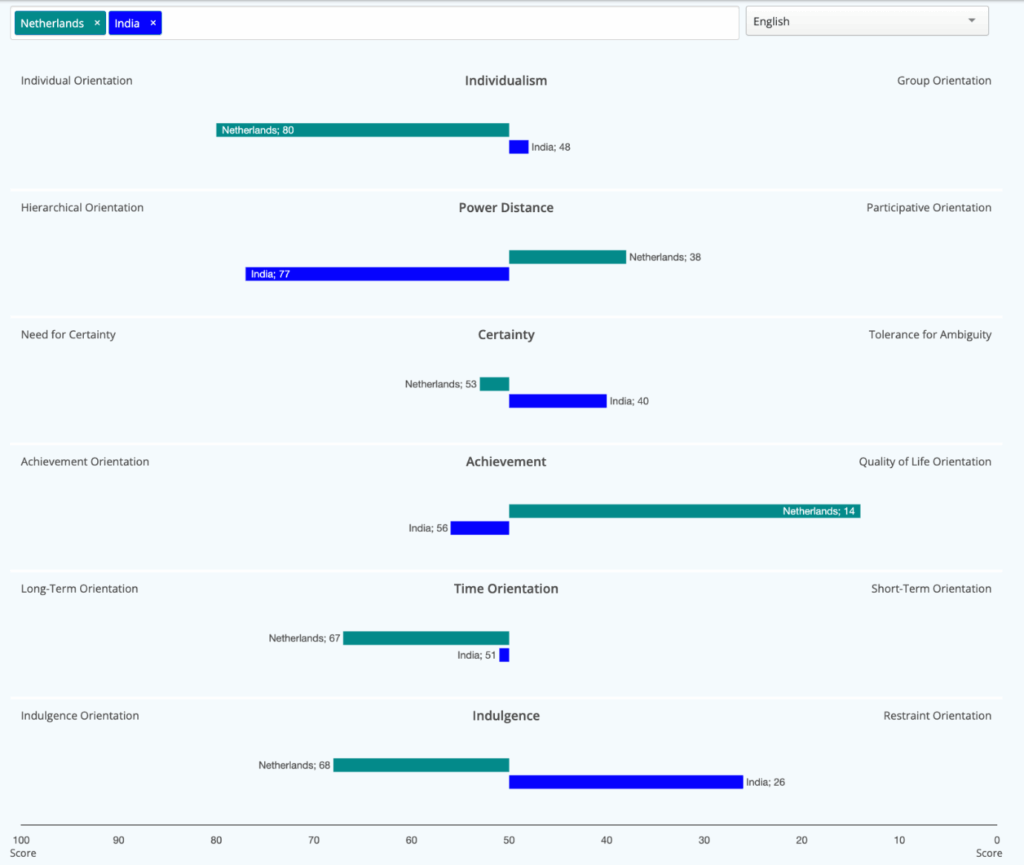
This section analyses the cultural contrast between Indian and Dutch work values based on Hofstede’s value dimensions. These differences have real-life implications in how people collaborate, make deci-sions, communicate, and lead within the multinational supermarket franchise under study. Using both the Hofstede framework and the concept of synthetic cultures as described in Exploring Culture by Hofstede, Pedersen & Hofstede (2002), this comparison seeks to highlight the cultural limitations and enablers in intercultural work settings.
- Power Distance (Hierarchy Dimension)
India scores high on power distance, which translates to a preference for hierarchy, deference to au-thority, and top-down decision-making. This aligns with the synthetic culture profile “Hipow,” where leaders are expected to instruct and be obeyed. The Netherlands scores much lower, favouring an egalitarian workplace where informal communication is the norm. This reflects the “Lopow” synthetic culture, where status differences are minimised.
Impact: In the Dutch office, junior employees may feel comfortable questioning or proposing new ideas, while Indian colleagues may remain reserved. This mismatch in expectations can lead to misunder-standings about initiative and respect. - Individualism vs. Collectivism (Identity Dimension) India reflects a collectivist tendency, aligning with the synthetic culture “Collec,” where group loyalty and harmony take priority. Employees may seek consensus and avoid open disagreement. The Netherlands is highly individualistic, similar to “Indiv,” where autonomy, directness, and personal goals are important. Impact: Dutch employees may expect open, assertive contributions, which can be perceived as con-frontational by Indian team members. Conversely, Indian colleagues might be seen as passive or un-clear in their communication.
- Masculinity vs. Femininity (Gender Dimension)
India shows moderate masculinity. Success, status, and achievement are visible motivators, aligning with the synthetic culture “Mascu.” The Netherlands is one of the most feminine cultures globally, re-sembling “Femi” in its emphasis on work-life balance, caring, and modesty.
Impact: Dutch teams often seek consensus and favour modesty, while Indian professionals might be more goal-focused and performance-driven. The Dutch may find the Indian approach too competitive, while Indians may perceive the Dutch as unambitious. - Uncertainty Avoidance (Truth Dimension)
India scores lower on uncertainty avoidance, reflecting a greater comfort with ambiguity and change. This matches “Weak Uncertainty Avoiding” synthetic culture types. The Netherlands has moderate to higher uncertainty avoidance, preferring clear rules and expectations, similar to “Strong Uncertainty Avoiding” cultures.
Impact: Indian employees might adapt quickly to shifting priorities, while Dutch colleagues may expect more structure and planning. Misaligned expectations can affect project timelines and quality. - Long-Term vs. Short-Term Orientation (Virtue Dimension)
India scores midrange, balancing traditional values with adaptability. The Dutch are clearly long-term oriented, mirroring the synthetic culture of “Long-Term Orientation,” which values investment in future outcomes and sustainability.
Impact: Dutch colleagues may prioritise long-term goals and sustainability, while Indian counterparts may be more pragmatic and responsive to immediate results. Conflicts may arise in planning and eval-uation phases of projects. - Indulgence vs. Restraint
India scores low on indulgence, identifying as a restrained culture. Expression of emotions is limited and gratification is delayed. The Netherlands scores high on indulgence, where freedom of expression and leisure are highly valued. Impact: Dutch team members may view informal communication or emotional openness as part of workplace authenticity, while Indian colleagues may find this unprofessional or inappropriate.
Outcome
Cultural differences significantly influence collaboration, leadership, and decision-making within multi-national work environments. Using Hofstede’s dimensions as a framework, this analysis illustrates how Indian and Dutch employees may experience friction or synergy in a global supermarket franchise.
In hierarchical cultures like India (high Power Distance), employees may wait for explicit instructions and defer to superiors. Dutch employees, from a low Power Distance culture, are likely to take initiative and expect informal, egalitarian communication. This divergence can lead to misunderstandings, with Indian workers perceived as passive and Dutch workers seen as disrespectful of authority.
Cultural identity also plays a role. India’s collectivist values encourage group harmony and consensus, while the Netherlands’ individualism fosters directness and personal responsibility. As a result, Dutch employees may interpret indirect communication as evasiveness, while Indian colleagues may find the Dutch overly blunt or confrontational.
Differences in masculinity further impact team dynamics. Indian professionals may prioritize results and achievement, in contrast to Dutch colleagues who value modesty and consensus. Performance expec-tations can thus clash with work-life balance preferences.
Regarding uncertainty avoidance, Indian employees may comfortably adapt to shifting priorities, whereas Dutch teams typically expect clear guidelines. This mismatch can cause tension in project management, with Dutch staff seeking more structure than their Indian counterparts deem necessary.
Long-term orientation also creates a strategic gap. Dutch employees focus on sustainability and future growth, while Indian professionals may prefer short-term, flexible solutions. These contrasting ap-proaches can affect planning, investment, and evaluation.
Lastly, the indulgence dimension reveals differing attitudes toward emotion and expression. Dutch workers may embrace informal, emotionally open workplace interactions, which could be perceived as unprofessional or intrusive by Indian colleagues, who operate within a more restrained cultural frame-work.
To optimize cross-cultural teamwork, management should implement culturally sensitive communica-tion practices, encourage mutual respect, and provide intercultural training. This ensures that all em-ployees feel understood, valued, and equipped to contribute effectively within a diverse organizational culture.
Possible solutions
The organization created intercultural onboarding sessions and structured feedback systems to actively address cultural misunderstandings between Indian and Dutch employees. This approach reflects an ethnographic mindset by engaging people within their cultural environment and respecting how they communicate, both explicitly and implicitly. For example, while the Dutch colleagues were prompted to change their style of direct communication with the whole team, the Indian colleagues were given more opportunities to share feedback on an individual basis, like speaking with the manager or writing in a survey without their names. This helped to equalize the differences in preference for feedback. Addi-tionally, the organization offered workshops to explore cultural values, communication styles, and work-place expectations. These sessions encouraged employees to reflect on how cultural beliefs influence teamwork and leadership. By doing so, team members developed a shared understanding and learned to interpret behaviors within the correct cultural context.
This initiative fostered mutual respect and improved collaboration across offices. By basing the solution on real employee experiences and cultural insights, the organization created a sustainable and inclusive way to manage intercultural challenges
Authors
Leonor Catanho Pinto (www.linkedin.com/in/leonor-pinto-1874902aa) Student: International Business, Amsterdam University of Applied Sciences Block 4, Semester 2, 2024/2025
Kylie Tang (https://www.linkedin.com/in/kylie-tang-784374299?utm_source=share&utm_campaign=share_via&utm_content=profile&utm_me-dium=ios_app
Student: International Business, Amsterdam University of Applied Sciences Block 4, Semester 2, 2024/2025
Silvia Borisova (https://www.linkedin.com/in/silvia-borisova-025458211/)
Student: International Business, Amsterdam University of Applied Sciences Block 4, Semester 2, 2024/2025
Sevda Tuna (https://www.linkedin.com/in/sevda-tuna-05043b296?utm_source=share&utm_cam-paign=share_via&utm_content=profile&utm_medium=ios_app) Student: International Business, Amsterdam University of Applied Sciences Block 4, Semester 2, 2024/2025