Date
July 2th, 2025
Categories
Intercultural Communication, Public Service and Governance, Business Culture, Communication Strategies
Key words
Culture, communication, Hofstede, workplace, cultural differences
Excerpt
This report examines intercultural communication in the workplace, utilizing Hofstede’s dimensions to compare cultural differences and provide strategies for enhancing communication effectiveness.
Overview
Intercultural communication is crucial for fostering equitable and productive interactions in today’s globalized society, particularly in multicultural cities like Amsterdam. This study explores how cultural frameworks influence barriers, expectations, and communication styles. It focuses on the Netherlands and Morocco, two cultures that often intersect in public service and urban policy contexts, using Hofstede’s Cultural Dimensions as a framework. The study also includes practical insights from an interview with a public sector employee involved in intercultural outreach, highlighting how these cultural differences manifest in actual governance.
Culture influences not only behavior but also how that behavior is interpreted. As Weaver (2013) explains, making assumptions based solely on surface observations can result in miscommunication. Similarly, Hofstede et al. (2002) emphasize the importance of distinguishing between observation and interpretation. Behaviors that may appear straightforward in one culture can hold entirely different meanings in another.
Hofstede Dimensions
Bridging cultural divides necessitates an understanding of how values shape behavior. Hofstede’s framework allows us to compare national cultures using measurable dimensions. His six dimensions provide a valuable lens through which to examine the cultural influences on authority, communication, and everyday conduct, particularly in the contexts of the Netherlands and Morocco.
The Netherlands has a significantly higher individualism score of 80, indicating a culture that values independence, self-reliance, and unrestricted self-expression. In contrast, Morocco, with a score of 46, is more collectivist, prioritizing harmony within the group and loyalty to family or community. This cultural difference may explain why Moroccan contexts, which favor diplomacy and indirect communication, may perceive the Dutch directness as blunt.
Another important contrast is in Power Distance. The Netherlands, with a score of 38, promotes equality and flat hierarchies, while Morocco, with a score of 70, shows a greater acceptance of hierarchical structures and formal respect for authority figures. Different expectations regarding status and interaction, based on cultural norms, were highlighted during an interview when a Dutch civil servant’s handshake was considered inappropriate.
In terms of certainty, Moroccan culture (68) tends to avoid uncertainty more than Dutch culture (53). This suggests that while Dutch culture is more open to ambiguity and creativity, Moroccans often prefer structure, clarity, and formal rules to minimize confusion. To prevent misunderstandings in official communication, the interviewee illustrated this point by using visual aids and simplified language.
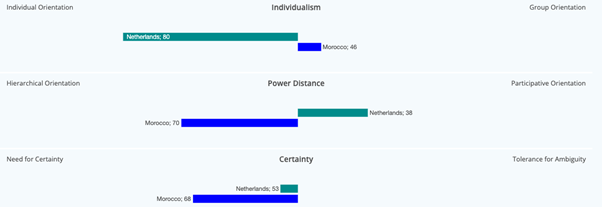
Figure 1: Hofstede’s Dimensions: https://cultureinworkplace.com/country-comparison-dashboard/?ode-country-selected=NL,MA
The Netherlands has a low achievement score (14), reflecting a feminine culture that prioritizes quality of life, cooperation, and modesty. In contrast, Morocco’s moderate score of 53 indicates a more masculine orientation, emphasizing competition, ambition, and visible success. While the Dutch may place a higher value on work-life balance and emotional transparency, Moroccan norms tend to emphasize formality and strength. These cultural orientations influence how individuals express their emotions and what is expected of them in the workplace.
In terms of time orientation, the Netherlands (score: 67) places a high value on sustainability and long-term planning. People there are focused on future goals and long-range objectives. In contrast, Morocco (score: 14) tends to prioritize the present, balancing traditional values with contemporary demands. This difference influences how citizens respond to new initiatives or policy changes.
When it comes to indulgence, the two countries also differ significantly. The Netherlands (score: 68) embraces indulgent values, prioritizing leisure, individual fulfillment, and self-expression as important aspects of life. Conversely, Morocco (score: 25) adopts a more restrained approach, where social and religious expectations may limit personal gratification. These contrasting attitudes toward enjoyment and self-control can impact social interactions, public gatherings, and workplace behavior.
Understanding the various dimensions of communication helps explain how a single gesture or choice can be interpreted differently across cultures. For instance, in Moroccan contexts, what might be considered assertive or transparent in Dutch communication could be seen as improper or disrespectful. By recognizing these differing frameworks, professionals can navigate cultural differences more effectively, avoid unintentional offenses, and foster more respectful and inclusive interactions.
Cultural norms are often deeply ingrained, as explained by Hofstede et al. (2002) in their synthetic culture exercises. Professionals benefit from modeling cross-cultural interactions, which helps them become more aware of these norms. This highlights the need for public institutions to develop advanced, experience-based intercultural skills, in addition to possessing general cultural knowledge.
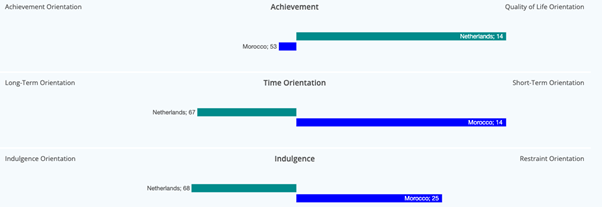
Figure 2: Hofstede’s Dimensions: https://cultureinworkplace.com/country-comparison-dashboard/?ode-country-selected=NL,MA
Outcome
During the interview, clear examples of how intercultural communication is managed in public service were provided. One significant incident involved a civil servant who shook hands with a resident. This gesture was considered inappropriate due to cultural and gender norms. However, this situation became a valuable teaching moment that reinforced the importance of cultural sensitivity and led to team discussions (Interview, 2025).
The interviewee highlighted the frequent use of interpreters, especially in the legal, medical, and educational sectors. To ensure that residents understand important information, they emphasized the municipality’s policy of providing information in multiple languages and, when necessary, simplifying the Dutch language (Interview, 2025). This approach aligns with Hofstede et al.’s (2002) warning that words may carry culturally specific meanings unless culturally adjusted, potentially leading to misunderstandings even after translation.
Regular staff training focuses on addressing unconscious bias and promoting polite communication. The municipality prioritizes collaboration with NGOs and neighborhood associations to assist all citizens, including those without documentation. To foster dignity and trust, the interviewee highlighted the importance of using neutral language, such as referring to individuals as “undocumented” instead of “illegal” (Interview, 2025).
Lastly, initiatives like “Taal voor Thuis” were emphasized as effective inclusion efforts that support parents who do not speak Dutch in their children’s education. These results demonstrate how cultural sensitivity and real-time feedback can influence institutional practices (Interview, 2025).
Possible solutions
The handshake, while considered a polite gesture in Dutch culture, can be inappropriate in other cultures. This difference led to a misunderstanding during the interview. This situation highlighted how assumptions based on one’s cultural standards can unintentionally harm cross-cultural interactions.
The municipality could improve its interactions with the public by assigning a cultural liaison or mediator to teams that engage with residents. These liaisons would help facilitate initial interactions with culturally diverse individuals by interpreting not only spoken language but also subtle cultural cues that affect trust, such as body language, formality, and social boundaries. This approach aligns with current initiatives to enhance communication channels and prevent disputes before they arise.
Furthermore, if scenario-based intercultural training—based on real situations—were expanded, staff would be better equipped to understand how minor actions might be perceived through different cultural perspectives. By ensuring that all citizens feel valued and understood, these measures would support the municipality’s shift from a model of formal equality to one of practical equity.
These suggestions align with the strategy outlined by Hofstede et al. (2002) for promoting intercultural competency through synthetic dialogue and cultural simulations. By employing these techniques, public employees can engage in empathy-driven communication that reflects real experiences and can practice interactions in safe environments.
Biography/references
Hofstede, G. J., Pedersen, P. B., & Hofstede, G. (2002). Exploring culture: Exercises, stories, and synthetic cultures. Intercultural Press.
Interview. (2025). Personal communication, conducted as part of the Intercultural Communication course project. Amsterdam University of Applied Sciences.
ITAP International. (n.d.). Country comparison dashboard: Netherlands vs. Morocco. Culture in the Workplace™. https://cultureinworkplace.com/country-comparison-dashboard/?ode-country-selected=NL,MA
Weaver, G. (2013). Intercultural relations: Communication, identity, and conflict. Pearson Learning Solutions.
Authors
Stundent: Indy Kaandorp. (Bedrijfskunde -Voltijd)
Block 4,Semester 2,2025
https://www.linkedin.com/in/indy-faye-kaandorp-2359b0345
Student: Kaoutar Zadou. (International Business – Full Time)
Block 4, Semester 2, 2025
https://www.linkedin.com/in/kaoutar-zadou-258a1b115
Student: Karmen Hiis (International Business – Fast Track)
Block 4, Semester 2, 2025
www.linkedin.com/in/karmen-hiis-31325329a
Student: Mustafa Orhan Gedik. (International Business – Full Time)
Block 4, Semester 2, 2025