Date: June 20, 2025
Categories: Local Government, Multiculturalism
Key words: Dutch local government agency, Afghan refugee, Debt counseling program, Moral and financial obligations
Excerpt A group of three students from Amsterdam University of Applied Sciences interviewed a local government worker in the Netherlands to explore how cultural values and communication styles impact professional interactions. Using theories like Hofstede’s cultural dimensions and Weaver’s concept of moral circles, the group examined how intercultural differences may lead to misunderstandings, and how cultural awareness and sensitivity can improve collaboration and communication in diverse work environments.
Overview
This intercultural communication project was conducted by a group of three students from the Amsterdam University of Applied Sciences. The project is based on an interview with a Dutch civil servant employed by a local municipality. Her role involves supporting residents who face a range of personal and financial challenges. In her daily work, she often interacts with individuals from diverse cultural backgrounds, including refugees and newcomers. These encounters frequently involve differences in cultural values, expectations, and communication styles, which can sometimes lead to misunderstandings.
The goal of the interview was to explore the impact of cultural diversity within a government workplace. Public institutions in the Netherlands serve people from many different backgrounds and often employ staff from varied cultural origins as well. While this diversity brings many benefits, it can also result in communication challenges, especially when there are language barriers or differing cultural norms and moral frameworks. The interview focused on how civil servants manage these situations and what tools and strategies they use to ensure effective communication and support. The interviewee explained that she has access to interpreters and other resources that help her engage with clients in a respectful and solution-oriented way.
Interview and Case Description
During the interview, the government employee emphasized the importance of aligning perspectives within teams to avoid miscommunication, especially in situations where cultural norms differ. For example, differing views on women’s roles in society can lead to clashes in expectations around independence and responsibility. To support inclusive practices, the organization implements various diversity and inclusion measures such as fair hiring policies, cultural sensitivity training, and regular case reviews to prevent discrimination. To overcome communication barriers, the civil servant has access to a range of tools and support systems. These include multilingual colleagues, professional interpreters, translation services, and informational materials available in multiple languages, including formats suitable for individuals with low literacy. Flexible policies are also in place to accommodate religious or cultural holidays. The interview further highlighted that decision-making within the organization involves a balance between individual responsibility and team-based input, particularly in complex cases. While decisions are grounded in law, there is room for flexibility depending on the context, experience level, and team support.
The case described in this project is based on the experiences shared during the interview. The civil servant regularly works with residents from refugee and immigrant backgrounds. She emphasized that differences in cultural expectations and communication styles can affect how services are both offered and received. One of the key challenges she highlighted is the presence of language barriers, which can make it difficult to understand a client’s perspective or explain official procedures clearly. One example she gave was about an Afghan refugee family. The family had gone through a lot and had to flee the country. They lived in Turkey for some time before they arrived in the Netherlands. Even though the man was receiving welfare support, he also worked as an informal delivery driver to earn extra money to be able to his help his mother and sister, who were still in Afghanistan and not allowed to work under the regime there. The family was struggling with debt, and the agency wanted to help them through a debt counseling program. But the man continuously refused to join, not being able to properly communicate and explain his reasons for doing so.
Hofstede Dimensions
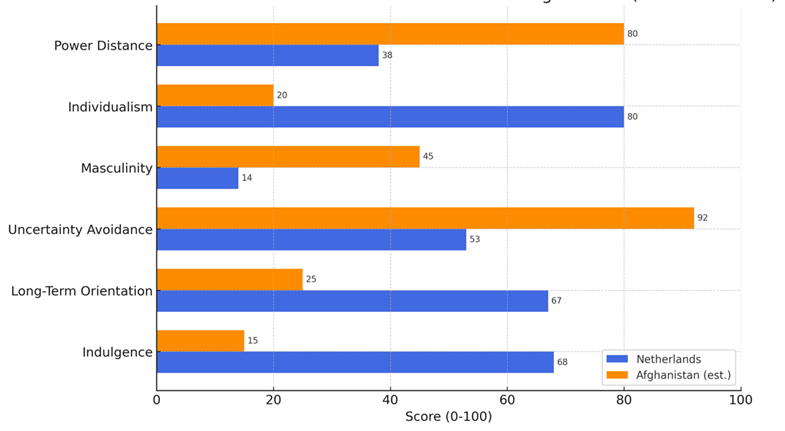
To better understand the cultural challenges that arise when Dutch professionals work with Afghan clients, we used Hofstede’s six value dimensions. Figure 1 presents Hofstede’s six value dimensions and shows the clear cultural differences between the Netherlands (blue bars) and Afghanistan (orange bars), based on estimated and published scores (Hofstede Insights, 2023). These visual distinctions help contextualize the practical communication challenges faced by Dutch professionals. Each of these dimensions plays a role in shaping how people communicate, make decisions, and respond to authority or support services (Hofstede et al., 2002).
Power Distance (PDI)
The Netherlands scores relatively low (38) on power distance, reflecting a culture that values flat hierarchies, open dialogue, and equality between authority figures and subordinates (Hofstede Insights, 2023). In contrast, Afghanistan scores very high (80), indicating a strong respect for hierarchy and centralized decision-making (Eriksen, 2021). In Afghan culture, it is considered inappropriate to question or challenge authority. This difference can be seen in how Afghan clients may hesitate to express disagreement or concerns, while Dutch professionals might expect more transparency and assertiveness.
Individualism vs. Collectivism (IDV)
With a high individualism score of 80, Dutch culture emphasizes autonomy, self-expression, and personal achievement (Hofstede Insights, 2023). Afghanistan, on the other hand, scores just 20, highlighting a collectivist orientation where family, loyalty, and group obligations are central (Eriksen, 2021). This was clearly reflected in the case where the Afghan man refused to join the debt counseling program because of his moral obligation to financially support his mother and sister back home. While Dutch professionals may focus on individual financial recovery, Afghan clients may see such priorities as conflicting with their duty to the collective.
Masculinity vs. Femininity (MAS)
Dutch culture is one of the most feminine in Hofstede’s model, with a low score of 14. It prioritizes care, quality of life, and consensus (Smith, 2015). Afghanistan scores 45, placing it in a moderately masculine zone, where traditional gender roles, assertiveness, and responsibility are more emphasized (Eriksen, 2021). In the case, the man’s strong sense of responsibility as the only male provider in his family aligns with this cultural expectation. For Dutch professionals, this gender-based role may not be immediately understood, as Dutch society tends to value equal and flexible roles regardless of gender.
Uncertainty Avoidance (UAI)
Afghanistan scores extremely high on uncertainty avoidance (92), showing a cultural preference for structure, tradition, and clear rules (Eriksen, 2021). The Netherlands, with a moderate score of 53, is more tolerant of ambiguity and open to flexibility (Hofstede Insights, 2023). This means Afghan clients may struggle with loosely structured systems or services that require independent decision-making. The use of a cultural mediator or interpreter can help bring clarity and stability in such situations, reducing anxiety and resistance.
Long-Term Orientation (LTO)
The Netherlands scores relatively high (67), reflecting a pragmatic approach that values planning and investment in the future (Hofstede Insights, 2023). Afghanistan, with a score of 25, is more short-term oriented and focused on tradition and fulfilling immediate obligations (Eriksen, 2021). In the case, this was evident in the man’s prioritization of supporting his family over engaging in a program designed for long-term financial recovery. His sense of urgency came from cultural and moral expectations rooted in the present, not the distant future.
Indulgence vs. Restraint (IVR)
The Netherlands is considered an indulgent society, where people are free to express themselves and enjoy life (Hofstede Insights, 2023). Afghanistan is more restrained, shaped by modesty, religious discipline, and social norms (Barfield, 2010). This influences how emotions are expressed and how openly clients speak about their needs. Dutch workers may expect open communication, while Afghan clients may view restraint as more appropriate and respectful.
In summary, the Hofstede dimensions show significant cultural contrasts between Dutch and Afghan perspectives. These differences affect how people interpret support, express needs, and build trust. By using this model, Dutch professionals can better understand the “why” behind behavior and create more empathetic, culturally sensitive solutions.
Outcome
The local government agency eventually involved an interpreter to communicate with the Afghanistan man in his native language. This step helped build trust and allowed him to explain his situation fully. The local government agency team learned that his refusal was not based on misunderstanding or unwillingness to cooperate, but it was because of a deeply rooted moral obligation. In the moral circle of the Afghan refugee, it was prohibitive to stop sending money to his family abroad. He believed it was his duty, as the only male left in the family, to take care of his mother and sister. He was afraid that if he joined the program, he wouldn’t be allowed to send them money anymore, which is against his cultural and familial responsibilities.
Once the team understood this deeper cultural context of the man’s story, they were able to come up with the solution of involving his Mosque community. Through this network, a fundraising campaign was organized to support his family back home. As a result, the refugee was freed from his financial obligation to his family and felt comfortable entering the local debt counseling program.
The story of the Afghanistan refugee highlights how important it is to move beyond surface-level solutions and take the time to understand a person’s values, responsibilities, and cultural context. Most importantly, using culturally sensitive communication opened the door to mutual understanding and a practical outcome for all parties involved.
Possible solution
In addition to interpreters, local government agencies could use cultural mediators which are professionals that understand both the host country’s system and the cultural background of the client. In this way, the mediators can identify when a conflict is not just a financial or administrative issue but deeply rooted in values and moral obligations. In addition, local staff and workers who personally interact and converse with their clients should be culturally informed and trained to recognize these kinds of situations to prevent delays in service and build more effective communication. Regular intercultural training based on Hofstede’s cultural dimensions (Hofstede, Pedersen, & Hofstede, 2002) could help local government workers better understand their clients, and to be able to provide service in a way that the clients want and need while being culturally sensitive.
In this case, the local government worker can better understand why someone from a certain culture might prioritize family obligations over personal financial recovery. According to Weaver (2013), identity and group loyalty are often more important in collectivist cultures, and these cultural values directly influence how decisions are made. In the moral circle of the government worker, it may initially be inhibitive to see someone refusing help through a debt counseling program, as it goes against the commonly accepted goal of financial independence and stability. However, with proper intercultural training, the worker may become more aware of her own unconscious biases and develop a deeper understanding of the client’s cultural background. This allows her to respond with empathy and flexibility. This case shows that without cultural sensitivity, even well-meaning help can be misunderstood or rejected, but with the right awareness and tools, support can be adapted to meet people’s real needs.
Best Practice
Navigating a diverse workplace can lead to misunderstandings, often erupting from key cultural differences furthermore, language barriers are a major hurdle, as not everyone speaks fluent Dutch, leading to missed information and feelings of exclusion. Differences in gender roles can also cause friction; for instance, the Dutch emphasis on women’s financial independence might clash with more traditional expectations in other cultures, especiallyregarding family life. Varied work ethics are another point of contention; some colleagues might adhere strictly to a 9-to-5 schedule, while others, due to cultural or religious practices like fasting during Ramadan, may have different working rhythms, which can be misconstrued as a lack of commitment. Finally, different interpretations of problems mean what one person sees as a serious issue might not be viewed the same way by someone from another background, leading to team disagreements. Ultimately, these examples given above can highlight the critical need for open communication and cultural awareness to bridge gaps and foster a more inclusive and productive working environment.
It is a major point to foster cultural awareness and sensitivity in any organization because it leads to better understanding, respect, and much smoother communication. From what the government employee has shared, her workplace does a great job of promoting this in a few keyways. First, they provide training on cultural values and norms. This helps employees learn about different customs and perspectives, so they can avoid making assumptions and approach situations with more thoughtfulness. It’s all about understanding where others come from. Then there’s a focus on clear communication and constant alignment. Because cultural backgrounds can really shape how people see problems, it’s crucial to regularly check in and make sure everyone is on the same page. This prevents misunderstandings from festering.
To tackle language barriers, the organization makes excellent use of language tools and translators. They have multilingual staff and bring in external interpreters, whether from asylum centers or through phone services. Plus, they make sure important information is available in multiple languages, like Arabic and English, which is a huge help. They also offer flexible systems. A great example is allowing employees to swap public holidays like Christmas for holidays that are more significant in their own culture, like Eid. This simple act goes a long way in making people feel truly included and respected. Finally, for more complex situations, they rely on team-based decision making. This means different perspectives are brought to the table, and they’re not afraid to bring in outside experts when needed. It ensures that solutions are fair and well-rounded, considering all angles (Bloznails, 2025).
Authors
Jewelle Anne Reyes (International Business – Fast Track)
Student: Faculty of Business and Economics Amsterdam University of Applied Sciences, The Netherlands
Block 4, Semester 2, 2025
www.linkedin.com/in/jewelle-anne-reyes-115184358
Matijs Benjamin Beijer (Business Administration)
Student: Amsterdam University of Applied sciences, The Netherlands
Block 4, Semester 2, 2025
https://www.linkedin.com/in/tijs-beijer-735b28290
Marouan Babou (Internationa Business – Full-Time)
Student: Faculty of Business and Economics Amsterdam University of Applied Sciences, The Netherlands
Block 4, Semester 2, 2025
https://nl.linkedin.com/in/marouan-b-33101b223?trk=people-guest_people_search-card