Overview
The head of legal affairs and sustainability at a Finnish mobile device manufacturer oversees responsibilities related to governance, ethics, and long-term impact. The company emerged after taking over a well-known mobile phone business in the mid-2010s and operates as a global organization with a presence in more than 150 countries, serving highly diverse markets across Europe, Asia, the Middle East, and the Americas.
The company’s mission is strongly rooted in huma-centric values, which are most of it is inherited from the company’s organizational culture. These values include respect for the individual, fairness, inclusiveness, diversity, and adherence to human rights principles. According to the interviewee, these values are reflected not only in internal company culture but also in how they conduct business globally, for example, through ethical manufacturing, protection of personal data, and providing affordable mobile devices for different socioeconomic groups.
Intercultural communication plays a crucial role in organization’s daily operations. He highlights that Finnish communication tends to be very direct, which can be effective internally but may be perceived as rude or confrontational in other cultures, especially Asian contexts where politeness, hierarchy, and indirect communication are more valued.
Hofstede Dimensions
Power distance refers to how much hierarchy and unequal power are accepted in a culture. The organization reflects a low power distance culture, influenced by Finnish and Nordic values, where leadership is democratic, and everyone is encouraged to share ideas. In contrast, many Asian mostly Chinese) operate with high power distance, where decisions are made by senior leaders, questioning authority is uncommon (Hofstede et al., 2010). This contrast has led to misunderstandings in cross-cultural interactions, particularly when his direct communication style was interpreted as disrespectful or as causing someone to “lose face”.
Their culture emphasizes respect for the individual and personal responsibility, aligning with individualistic cultures common in Europe. Employees are encouraged to express their opinions openly. However, in more collectivist cultures, such as those in Asia and Africa, maintaining group harmony and relationships is more important than direct disagreement. This requires a more indirect and careful communication style (Hegerova, 2024).
The organization demonstrates moderate to high uncertainty avoidance through its focus on clear legal frameworks, NDA, and bilingual contracts. However, in some Asian markets, such formal legal protections are not always standard practice, and business relationships may rely more on trust and long-term relationships rather than formal legal structures, requiring HMD to adapt its processes. For example, the use of an NDA is not really common in China for the counterparties.
Finland is considered a feminine culture, valuing cooperation, equality, and quality of life. This is reflected in HMD’s focus on inclusiveness, fairness, work-life balance, and consensus-based leadership. A leadership approach that prioritizes collaboration and diverse perspectives aligns closely with this cultural dimension (Hofstede et al., 2010).
Lastly, the company demonstrates a long-term orientation, shown through long-term contracts and a strong focus on sustainability. This aligns well with many Asian cultures that value long-term relationships. However, the interview also highlights that legal systems may vary by region. For example, Legal systems in Europe and India are generally more independent and predictable, whereas legal disputes involving large Chinese companies can be extremely difficult due to the close ties between companies and government institutions (Hofstede et al., 2010.
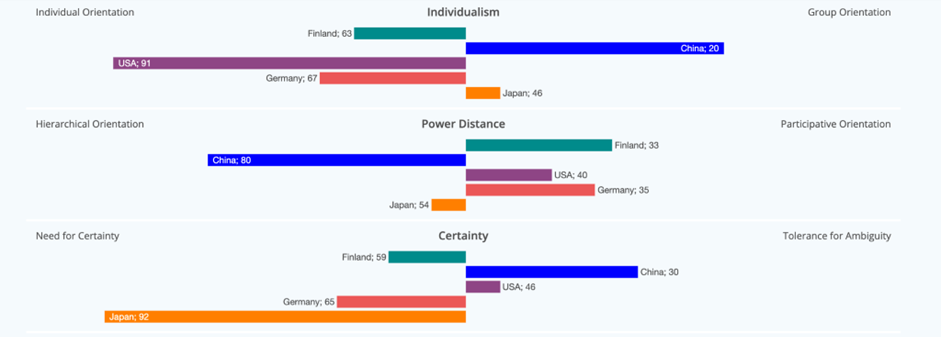
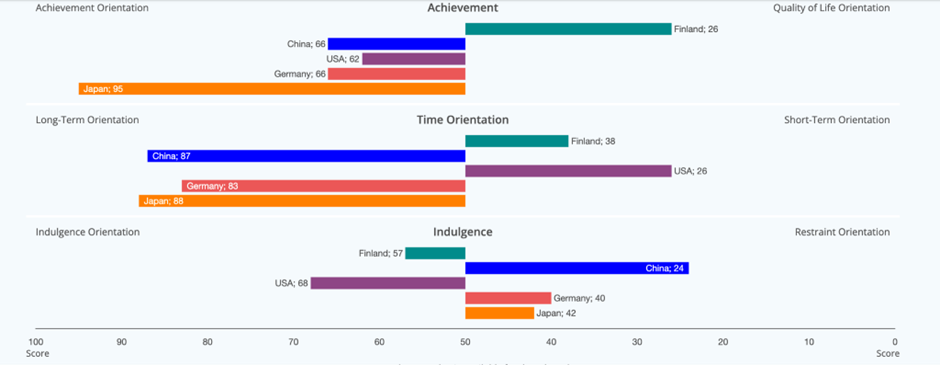
Figure 1: Hofstedes Dimenssions (Country Comparison – Culture in the WorkplaceTM, n.d.)
Outcome
The interview suggests that the intercultural problems faced by the organization stem from differences in communication approaches and expectations regarding hierarchy, rather than from issues of respect and professionalism. Finland is known for direct and task-oriented communication. This is actually more common in low-power-distance situations. However, direct communication may be viewed as “too harsh and even disrespectful,” especially when addressing a person higher in the hierarchy, and there is a danger of “losing face,” as found in some Asian cultures (Hofstede et al., 2010).
The second result is that the legal approach to the company’s operations demonstrates the company’s strategy to avoid uncertainty through the use of formal contracts, agreements, and non-disclosure agreements. Interviewee argues that in other markets, the formal approach may not be the norm at the beginning of a cooperation, as market engagement is often based on trust and relationship-building. If the strategies are divergent, negotiations can take a long time and be challenging.
In conclusion, to communicate effectively across cultures in the company, one must strike a balance between clarity and cultural sensitivity, including the tone of legal and ethical standards and the style of feedback.
Possible solutions
Thus, the organization can facilitate easier intercultural collaboration by adopting effective behaviours to avoid confusion without compromising laws and regulations. For effective collaboration, a quick pre-task cultural scan should be conducted before engaging in crucial conversations to recognise the other party’s cultural background and communication patterns, particularly focusing on the context, whether it is a low- or a high-context situation, to ensure an effective and compatible initial engagement and response to the other party’s expectations and behaviours (EBSCO, n.d.; FutureLearn, n.d.). For a more effective and non-confrontational engagement in a face-sensitive and high-context situation, it is essential to avoid confusion and bluntness in corrections and criticisms by asking instead, “Do we want to adjust the way?” and “Could we explore another way?” rather than bluntly saying “Don’t do it” and “Change it,” considering that different cultures have different feedback expectations and blunt corrections could damage the relationship and collaboration process (Meyer, 2014). To avoid confusion and misunderstanding, a clarity-check process is required after calls and emails, rather than assuming understanding, by confirming understanding with a quick, easy-to-understand statement and ensuring clarity through a series of basic lines and phrases (EBSCO, n.d.).
Two other elements can be helpful in a hierarchical/relationship-first context: aligning the meeting processes with the level of the hierarchy being addressed and making the authority in decisions explicit, as power distance can influence who can speak up in a discussion or make decisions in a timely fashion, which can hinder progress on a case (Hofstede, n.d.). If the early formal legal approach seems inappropriate in some context, consider a staged approach in which a less formal initial agreement is used before proceeding to detailed contracts as trust is built in the relationship, in part because this can facilitate accommodation without “losing oneself” or compromising one’s standards in the process (Molinsky, 2013).
References
Country Comparison – Culture in the WorkplaceTM. (n.d.). Culture in the WorkplaceTM. https://cultureinworkplace.com/country-comparison-dashboard/?ode-country-selected=FI,CN,DE,JP,US
EBSCO. (n.d.). High-context and low-context cultures. EBSCO Research Starters. Retrieved January 23, 2026, from https://www.ebsco.com/
FutureLearn. (n.d.). What is high-context and low-context culture? Retrieved January 23, 2026, from https://www.futurelearn.com/
Hegerova, Z. (2024, November 28). Building relationships in collectivist workplaces. Headroom Mental Health. https://headroom.co.za/building-relationships-in-collectivist-workplaces/
Hofstede, G. (n.d.). The 6-D model of national culture. Geert Hofstede. Retrieved January 23, 2026, from https://geerthofstede.com/
Meyer, E. (2014, February 25). How to say “This is crap” in different cultures. Harvard Business Review. https://hbr.org/2014/02/how-to-say-this-is-crap-in-different-cultures
Molinsky, A. (2013, March 12). When crossing cultures, use global dexterity. Harvard Business Review. https://hbr.org/2013/03/when-crossing-cult
Authors
Students:Block 2, Semester 1, 25-01-2026
Alma Eekhout Conde, (https://www.linkedin.com/in/alma-eekhout-conde-5b22021b5/)
Karlo Koljonen, (https://www.linkedin.com/in/karlo-koljonen-626478390/)
Aisha Mohamed, (https://www.linkedin.com/in/aisha-mohamed-208545257/)
Dain Yoon, (https://www.linkedin.com/in/dainyoon/)
Yianna Reinking: (www.linkedin.com/in/yianna-reinking)