Overview
The company is a part of a global hospitality industry that delivers high-quality service and fosters a diverse and inclusive culture. The hotel located in The Netherlands is a destination for both business travelers, tourists and guests who come from a wide range of countries across Europe and from all around the world. Due to the diverse backgrounds, not all clients are fluent in English, which is mainly used in communication between the staff and guests. Many guests rely on basic English, gestures or support from multilingual staff to express their needs. As a result, cultural differences in communication styles and expectations of service vary depending on the customer, which creates challenges for the company.
The company’s vision is to be the first choice when it comes to guests who value genuine hospitality, and its mission is to provide an excellent service and create memorable experiences for guests from diverse cultural backgrounds. Additionally, the company has a clear hierarchical structure in which strategic decisions and cultural initiatives are led by senior management. Nevertheless, there are potential misunderstandings related to hierarchy and stress at work because both the individual personality and cultural background of the employees affect how they respond to stress and instructions.
Hofstede Dimensions
Cultural differences in the organization can be explained by Hofstede’s dimensions of value, given that employees of different cultures work in the organization. Cultural differences affect communication, organizational structure, responsibility, and handling stress at work. In a service-oriented context, differences will directly influence decisions and work performance, as well as how employees relate to their work personally.
Power Distance Index can be observed through how workers react to management and instructions. Some workers may want clear instructions from management, while others may want to be left alone to act on their own. Such differences may lead to how decisions are executed, especially when it is busy. On the other hand, it may lead to how workers are either empowered or limited by management.
Individualism versus Collectivism is reflected in the degree to which the team-working style is preferred over the individual working style. Whereas some workers would thrive on frequent communication, others would work better on their own. This directly influences task delegation and ownership. A blend of the two will help to ensure proper decision-making.
Uncertainty Avoidance is a factor in how workers react to pressure, to unforeseen changes and to stressful situations. While some workers are composed and methodical in their behavior in such situations, others may feel increased levels of stress or act on instinct. It is because of culture that workers behave in this way. To mitigate this effect, supervisors provide workers with clear instructions and systematic procedures, especially in handovers.
Differences related to Masculinity versus Femininity are found in the way people communicate. Some employees are very direct and task-oriented while others are very polite and indirect. Such differences can result in misunderstandings due to different styles of communication. Supervisors can be aware of these differences and change their own communication styles to facilitate respect and easy decision-making.
Long-term orientation is expressed through operational methods such as structured handovers, written lists of tasks, and documentation. Such methods prioritize continuity with a focus on long-term optimization instead of short-term problem-solving. This is very helpful for intercultural collaboration because it avoids reliance on implicit assumptions. Overall, Hofstede’s Value Dimensions are a good means of explaining how values affect behavior in an organization.
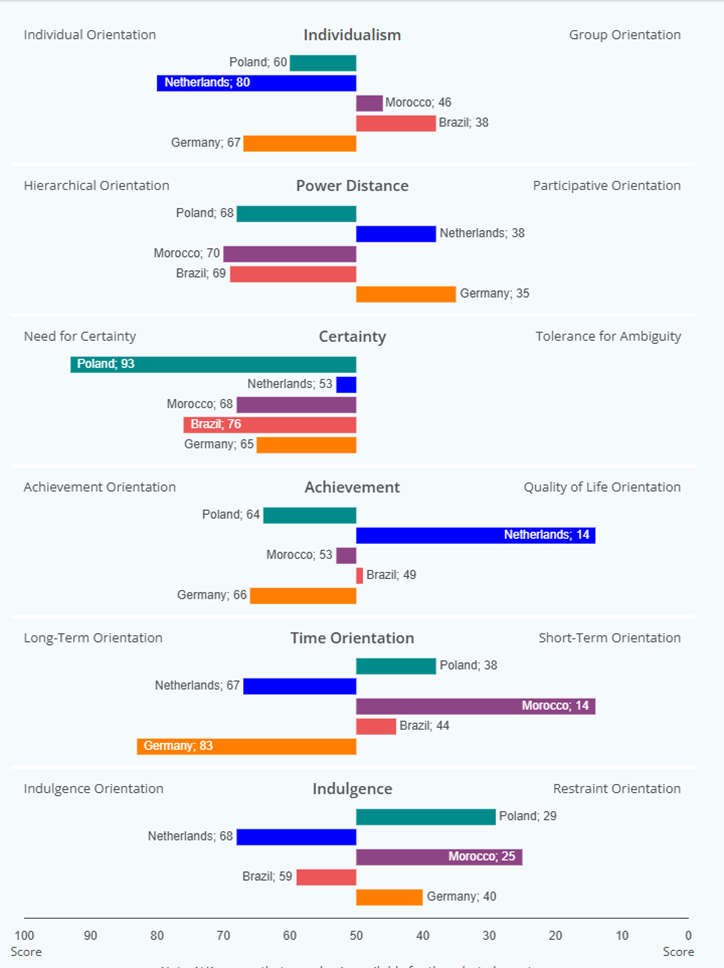
Figure 1: Hofstedes Dimenssions: https://cultureinworkplace.com/country-comparison-dashboard/
Outcome
In the Front Office team, the main intercultural communication issue is that the same message can be understood differently because of language level, communication style, and hidden cultural norms. English is the shared working language, but for most staff it is not their first language, which increases misunderstandings – especially when information is technical or must be transferred quickly. The interviewee explains that these differences become most visible during shift handovers, complaint handling, and emergency situations, because time pressure makes small misunderstandings more serious. Direct versus indirect communication adds another layer: some colleagues communicate very directly while others are more indirect, which can create confusion until people learn each other’s styles. Using Hall’s Iceberg Model, the visible part is the style (direct/indirect), but underneath are values about respect, hierarchy, and what is considered appropriate at work. Because of these hidden norms, communication can become inhibitive (people hesitate to clarify or speak up) and sometimes feel almost prohibitive (people feel they “cannot” question decisions due to cultural expectations).
Possible solutions
The solutions should reduce inhibitive silence and make shared meaning explicit. The interviewee already uses practical strategies like speaking slowly, using simple English, and showing examples. A stronger team-level approach is to standardize communication in critical moments: short confirmation loops, clear handover routines, and written checklists that everyone uses across shifts. This improves clarity and reduces uncertainty. Another solution is to agree on a shared feedback and escalation style, so directness is used for clarity but stays respectful, and indirectness is not interpreted as incompetence. Finally, inclusion improves when language support and development opportunities are transparent, because language barriers can otherwise indirectly limit access to certain roles and responsibilities.
Authors:
Students: International Business Amsterdam University of Applied Sciences
Block 2, Semester 1, 2026
Julia Szewczyk (https://www.linkedin.com)
João Pedro Lamas Paulino (https://www.linkedin.com/in/jo%C3%A3o-paulino-5976b6144/)
Quỳnh Nguyễn (http://linkedin.com/in/quỳnh-trâm-nguyễn-478ba8208)
Caesardo Diaz Afriansyah (https://www.linkedin.com)
Denys Shukhat (https://www.linkedin.com/in/denys-shukhat)
Mees Camoenie (https://www.linkedin.com/in/mees-camoeni%C3%A9-73a4a9386?trk=contact-info)