Excerpt
An interview was conducted with a detainee caretaker at a facility that deals with Immigration Centreto gain insight into intercultural communication in immigration detention. The interview focused on daily interactions with detainees from diverse cultural backgrounds, highlighting challenges such as language barriers, differing perceptions of authority, and gender-role expectations. The findings provide practical context for the theoretical analysis in this report.
Overview
This report analyzes intercultural communication in Immigration Centrein the Netherlands, based on an interview with a detainee caretaker.
Using Hofstede’s cultural dimensions as an analytical framework, it examines how differences in power distance, uncertainty avoidance, gender norms, and decision-making expectations shape interactions between detainees and staff. The report connects empirical findings to theory, evaluates institutional practices, and proposes recommendations to improve communication, trust-building, and conflict management in detention contexts.
Hofstede Dimensions
1. Power Distance Index
Hofstede’s power distance index is the amount of strength given to a society’s hierarchy and is very applicable to the content (Hofstede et al., 2010). The Netherlands scores somewhat low on power distance, meaning authority figures are generally expected to be approachable, and equality is emphasized. However, Iran scores higher on power distance index which shows a greater acceptance of an hierarchical structure and unequal power relations (Culture in the workplace, 2026).
This difference is visible in the interview where detainees display either extreme submissiveness or strong distrust toward authority figures. Tensions are evident when detainees struggle to accept instructions from female staff members, which shows culturally influenced expectations regarding authority and gender roles. These differences could possibly affect decision-making and communication, requiring staff to invest additional time in explaining procedures clearly and building trust while maintaining institutional authority (Interview, 2026).
2. Individualism vs. Collectivism
Individualism vs collectivism explains more of the intercultural differences (Hofstede et al., 2010). The Netherlands is a highly individualistic society, where someone’s personal autonomy and individual responsibility have more impact. Iran, on the other hand, is more collectivist and traditionally values family and community involvement in decision-making (Culture in the workplace, 2026).
However, the interview reveals that family involvement among detainees is rare. Many detainees make decisions independently due to shame, fear, or separation from family. This demonstrates that cultural values are not fixed and can be reshaped by situational factors such as migration, trauma, and legal vulnerability. As a result, professionals must avoid cultural assumptions and adapt their communication to the individual rather than relying solely on cultural background (Interview, 2026).
3. Uncertainty Avoidance Index
Hofstede’s uncertainty avoidance index helps in explaining the emotional reactions seen with detainees (Hofstede et al., 2010). Both the Netherlands and Iran show moderate to high uncertainty avoidance, but detainees (especially those with traumatic backgrounds) experience uncertainty far more intensely due to the lack of control over their legal situation (Culture in the workplace, 2026).
Uncertainty about detention length and case outcomes could lead to stress, anxiety, withdrawal, or aggressive behaviour. High uncertainty avoidance reduces detainees’ ability to process information rationally, which complicates communication and decision-making. The example of the Syrian detainee shows how calm communication, emotional reassurance, and the use of a detainee’s native language can reduce uncertainty and psychological noise, leading to de-escalation and more effective outcomes (Interview, 2026)
4. Masculinity vs. Femininity
Iran’s 43 is moderate, balancing achievement with relationships, but traditional gender roles persist, emphasizing modesty and care alongside some competitiveness. The Netherlands scores a very low 14 on masculinity, reflecting a highly feminine society that values cooperation, consensus, work-life balance, gender equality, and open emotional expression over aggression or status.
Gender-related tensions are common, per the interview, some detainees resist female authority or suppress emotions to appear “strong” (men more so), while women express sadness openly. These vary individually but stem from cultural norms clashing with Dutch equality. The feminine Dutch approach aids resolution through calm, respectful communication, as in the successful handling of a distressed Syrian detainee via empathetic listening and translation, ultimately locating his girlfriend and de-escalating a crisis.
5. Long-Term Orientation vs. Short-Term Orientation
Iran scores 14, indicating a strongly short-term normative orientation that emphasizes traditions, quick results, immediate social obligations, and respect for the past as well as present stability. The Netherlands scores 67 on long-term orientation, reflecting a pragmatic approach that emphasizes perseverance, future planning, thrift, and adaptability for sustained success.
Dutch legal processes, with their patient, procedural focus (e.g., appeals and integration planning), can frustrate short-term oriented detainees seeking rapid resolution, exacerbating uncertainty and anxiety. The interviewee’s emphasis on extra time for clear explanations aligns with bridging this gap, ensuring decisions aren’t rushed despite cultural impatience.
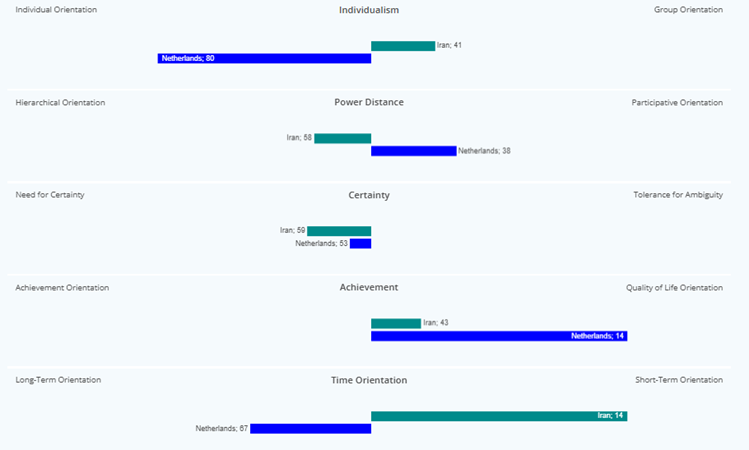
Figure 1: Hofstede’s Dimensions https://cultureinworkplace.com/country-comparison-dashboard/
Outcome
The interview with the detainee caretaker revealed that the Immigration Police operates within a complex intercultural environment in which Dutch cultural values strongly shape institutional practices, while continuous adaptation to detainees’ diverse cultural backgrounds is required. Core Dutch characteristics such as low power distance, direct communication, transparency, and rule-based decision-making are clearly reflected in daily interactions. At the same time, staff must adjust their approach when working with detainees from cultures that are more hierarchical, collectivist, or restrained. This combination results in a practice that blends formal institutional authority with situational cultural sensitivity, supporting both legal effectiveness and humane treatment (Interview, January 4, 2026).
By acknowledging cultural differences in perceptions of authority, gender roles, and uncertainty, the Organisation demonstrate how public institutions can navigate intercultural challenges effectively. Detainees from high power-distance cultures may either strongly distrust authority or display extreme submissiveness, which contrasts with the Dutch expectation of open communication and equality. Staff respond to these differences by remaining calm, providing repeated and clear explanations, and allowing extra time for trust-building. This approach aligns with Hofstede’s dimensions and helps reduce misunderstandings during interviews and hearings (Hofstede et al., 2010)
Moreover, the organization’s emphasis on clear and respectful communication reflects the Dutch low-context communication style, where transparency and explicit explanations are considered essential. However, language barriers frequently complicate this process. The consistent use of professional interpreters is therefore a key best practice, ensuring that detainees fully understand procedures and can accurately express their situation. This was particularly evident in the case of a Syrian detainee in severe emotional distress, where calm communication and accurate translation helped de-escalate a life-threatening situation and allowed the organization to respond appropriately (Interview, January 4, 2025). Such examples highlight how intercultural competence directly contributes to safety, trust, and ethical decision-making.
In addition, the interview revealed tensions related to gender roles and authority, especially when detainees from traditional or high-masculinity cultures interact with female staff members. While Dutch institutional norms emphasize equality and professionalism, these interactions sometimes create friction. Staff training in intercultural communication equips employees to manage such situations respectfully while maintaining Dutch legal standards (Interview, January 4, 2026). This reflects an institutional culture that values inclusivity and professionalism without compromising authority or legal obligations.
Furthermore, the Organisation operates within a structured, top-down legal framework, where decisions are ultimately guided by Dutch law and formal procedures. While this limits flexibility for both staff and detainees, it provides clarity and consistency in a high-stakes environment. At the same time, staff is encouraged to act proactively within their role by communicating transparently, showing empathy, and identifying risks such as trauma or self-harm. This balance between institutional hierarchy and interpersonal sensitivity is crucial in managing stress, uncertainty, and emotional responses among detainees (Interview, January 4, 2026).
In conclusion, the Organisation serves as a strong example of how an organization can integrate cultural awareness into a formal, authority-driven context. By combining Dutch cultural values of low power distance and direct communication with intercultural training, interpreter use, and emotional sensitivity, the organization enhances trust, fairness, and operational effectiveness. This approach not only improves outcomes for detainees but also strengthens the legitimacy, sustainability, and ethical standing of the institution within society.
Possible solutions
Based on interview findings and theory several solutions are proposed to enhance communication and decision-making within organisational settings.
1. Strengthening Training Through Scenario-Based Learning
While staff currently receive general intercultural training, their training should evolve to scenario-based learning to address behavioral challenges identified in the field. Training should be more in depth and transition away from abstract concepts to focus on realistic simulations like managing interactions with detainees who exhibit deep distrust of authority, extreme submissiveness, or resistance to female staff. This training allows personnel to practice de-escalation and trust-building strategies.
2. Institutionalizing Professional Interpretation
To reduce delays and emotional escalation, the Organisation should always use professional interpreter into the detention process. Language barriers are a primary driver of confusion and frustration during intake and legal briefings. As demonstrated by the case of the Syrian detainee, accurate translation is not only a logistical tool but a critical de-escalation mechanism that enhances safety and the perceived fairness of the decision-making process (Interview, 2026).
3. Gender-Sensitive Authority Protocols
To address tensions arising from differing cultural norms about gender and power, the immigrant police should implement role-based authority protocols. In cultures characterized with a high-power distance that support traditional gender hierarchies, detainees may struggle to abide the instructions from a female police officer. Clear guidelines should emphasize to the detainees that authority is derived from the professional role rather than the individual. In sensitive cases where the detainee refuses to follow instructions from a female officer, the immigration police should use a joint-staff presence. This means that there is both a male and female officers present to handle the situation with the detainee. Using this approach, the immigration police keep the Dutch equality standards without unnecessarily escalating conflicts with the detainees.
4. Structured Expectation Management
Many detainees experience anxiety due to unfamiliar legal procedures, unclear timelines, and the setting they are in. This is particularly the case among individuals from cultures with a short-term orientation or high uncertainty avoidance. To ease the tension of the detainees, staff should provide repeated, simplified explanations of procedural steps and timelines. Staff should provide visual aids where possible to clearly communicate the message. Allowing extra time for explanations helps prevent misunderstandings that could otherwise evolve into outbursts.
5. Proactive Management of Psychological Distress
Early identification of emotional and psychological distress must be a core priority for the officers. Detainees who experienced war or trauma may have heavy reactions, such as aggression or mental breakdowns, which could lead to escalated situations. Training staff to recognize warning signs and respond with calming but clear communication or immediate referral to support services, like physiatrist and/or therapists allows the organization to balance their legal responsibilities with ethical and humane treatment.
Authors
Achaira Suares (www.linkedin.com/in/achairasuares)
Student: International Business University of Amsterdam Applied Sciences
Block 2, Semester 1, 2026
Oriana Rivero (linkedin.com/in/oriana-rivero-196086298)
Student: International Business University of Amsterdam Applied Sciences
Block 2, Semester 1, 2026
Kristína Chalupková (www.linkedin.com/in/kristína-chalupková-443930332)
Student: International Business University of Amsterdam Applied Sciences
Block 2, Semester 1, 2026
Wonderful Owusu-Ansah (www.linkedin.com/in/wonderful-owusu-ansah-2b0bb0303)
Student: International Business University of Amsterdam Applied Sciences
Block 2, Semester 1, 2026
Amisha Chhibber (www.linkedin.com/in/amisha-c-70b98b250 )
Student: International Business University of Amsterdam Applied Sciences
Block 2, Semester 1, 2026
Jamil El Bahraoui (linkedin.com/in/jamil-mohammed-el-bahraoui-5a225838a)
Student: International Business University of Amsterdam Applied Sciences
Block 2, Semester 1, 2026