Overview
The councillor interviewed represents a municipality in the Netherlands, a local government body responsible for public service delivery, civic participation, and community governance. The munici-pality operates within the Dutch administrative system, which strongly emphasizes transparency, democratic participation, and direct citizen involvement in local decision-making.
Based on the interview, the municipality operates within an inclusive moral circle, based on the be-lief that all residents should have equal access to information and public services, regardless of their background or language. This commitment is reflected in the use of plain language and multiple communication channels to reduce prohibitive barriers. By doing so, it helps residents navigate local institutions and social norms, while ensuring that administrative processes do not become inhibitive for those unfamiliar with Dutch culture and governance.
However, differences in social norms and expectations about government can create real challeng-es. Many residents come from cultures where deference to authority is expected, making the munic-ipality’s participatory approach feel unfamiliar or even inhibitive. While Dutch culture encourages people to ask questions, seek information, and take part in decision-making, residents from other cultural backgrounds may be more inclined to wait for guidance from authorities. Bridging these dif-ferent expectations is one of the municipality’s main intercultural communication challenges.
Hofstede Dimensions
The interview findings can be analyzed using Hofstede’s Cultural Dimensions Theory (Hofstede, 2001; Hofstede Insights), which explains how cultural values influence communication, participation, and expectations towards government.
Power Distance (PDI)
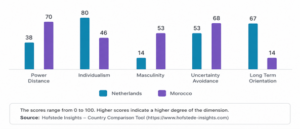
The interview illustrates differences in power distance through the councillor’s observation that some residents come from countries where governments make decisions with little citizen involvement. In contrast, Dutch society has a relatively low power distance, where citizens are expected to partici-pate in decision-making through consultations, public meetings, and initiatives such as the Citizens’ Assembly. The municipality actively encourages residents from all cultural backgrounds to engage in democratic processes by providing accessible information and removing communication barriers.
Individualism versus Collectivism (IDV)
The Netherlands is one of the world’s most individualistic societies, where personal responsibility and individual participation are highly valued. This is reflected in the municipality’s expectation that residents actively express their opinions and contribute to local policy. However, residents from more collectivistic cultures may rely more on family or community networks and may initially be less familiar with this participatory approach. By offering multilingual communication, using different communication channels, and organizing inclusive participation initiatives, the municipality aims to involve these groups more effectively.
Masculinity versus Femininity (MAS)
The Netherlands scores relatively low on masculinity, making it a feminine culture that emphasizes equality, cooperation, quality of life, and consensus. The interview strongly reflects these values, as the municipality focuses on inclusion, accessibility, equal opportunities, and ensuring that every resident feels represented regardless of cultural background or language proficiency. Rather than emphasizing competition or authority, the municipality prioritizes collaboration and community in-volvement.
Uncertainty Avoidance (UAI)
The interview demonstrates the importance of reducing uncertainty in communication. Residents who are unfamiliar with Dutch administrative procedures or who have limited Dutch language skills may experience uncertainty when dealing with municipal services. To reduce this, the municipality increasingly uses plain language, improves website accessibility, provides translations into lan-guages such as Turkish and Arabic, and communicates through multiple channels. These measures help residents better understand government procedures and encourage participation.
Long-Term Orientation (LTO)
The municipality’s communication strategy also reflects a long-term orientation. Instead of imple-menting temporary solutions, the municipality continuously invests in improving accessibility, digital communication, service delivery, and inclusive participation. The councillor emphasizes that creat-ing an inclusive municipality is an ongoing process requiring continuous evaluation and improve-ment. This long-term commitment helps build trust between residents and local government while strengthening democratic participation over time.
Overall, the interview demonstrates that the Municipality applies communication strategies that align closely with Dutch cultural values as described by Hofstede. By promoting equality, participation, accessibility, and continuous improvement, the municipality seeks to ensure
that residents from diverse cultural backgrounds can actively participate in local democracy.
Figure 1: Netherlands vs Morocco in Hofstede’s 5 Dimensions of Culture
Outcome
The interview shows that the municipality’s communication strategy is largely effective at promoting transparency and accessibility, but it also reveals a clear gap between the participatory expectations built into Dutch local governance and the expectations many residents bring from their own cultural backgrounds. While the municipality assumes that residents will actively seek information and take part in decision-making, residents from cultures with higher power distance or stronger collectivistic norms are often more accustomed to waiting for clear direction from authorities or relying on family and community networks rather than engaging individually. As a result, even well-designed commu-nication efforts do not always lead to equal participation across cultural groups.
This outcome indicates that the issue is not primarily a lack of information, since the municipality already provides plain language materials, translations, and multiple communication channels. In-stead, the gap stems from differing cultural expectations about the role of government and the ap-propriate way to engage with it. Closing this gap requires more than improved information delivery; it requires communication strategies that are specifically designed to bridge these underlying cultural differences. The following section outlines possible solutions that respond directly to this outcome.
Possible solutions
Several solutions can be derived directly from the cultural gaps identified above. To bridge differ-ences in power distance, the municipality could introduce structured civic orientation sessions for newcomers, particularly those arriving from countries with more centralized governance traditions. These sessions would explain, in clear and accessible language, how Dutch local democracy func-tions and why active participation is expected rather than optional. Partnering with trusted communi-ty leaders or cultural mediators to deliver this message can make the participatory approach feel less unfamiliar and help residents see it as an invitation rather than a demand.
Since residents from more collectivistic backgrounds often rely on family, religious, or community networks rather than individual initiative, the municipality could extend its outreach beyond direct, individual-facing channels. Working together with mosques, community centers, migrant organiza-tions, and informal community leaders would allow information about participation opportunities to travel through networks residents already trust. This approach would not replace existing digital and multilingual communication efforts but complement them, reaching residents who might otherwise remain disengaged.
To further reduce uncertainty for residents unfamiliar with Dutch administrative procedures, the mu-nicipality could offer low-threshold, informal entry points to participation, such as neighborhood walk-in sessions or small-scale feedback meetings, before inviting residents to more formal platforms like the Citizens’ Assembly. Combined with continued investment in plain language, translated materials, and visual or pictographic communication for residents with limited literacy, this scaffolded approach would help residents build confidence and familiarity step by step.
Finally, embedding intercultural communication training for municipal staff and establishing struc-tured feedback loops with diverse resident groups would support the municipality’s long-term com-mitment to inclusion. Regularly evaluating which communication strategies are effective and adjust-ing them based on resident feedback would ensure that the municipality’s approach continues to evolve alongside the needs of an increasingly diverse population.
Authors
Corina Arias Sanchez (www.linkedin.com/in/corina-arias-sanchez-33b3aa28a)
Student: International Business University of Amsterdam Applied Sciences
Block 4, Semester 2, 2026
LinkedIn URL: www.linkedin.com/in/corina-arias-sanchez-33b3aa28a
Rayan Raissouni (Rayan Raissouni | LinkedIn)
Student: International Business University of Amsterdam Applied Sciences
Block 4, Semester 2, 2026
LinkedIn URL: Rayan Raissouni | LinkedIn
Amir Doudouh (linkedin.nl/amirdoudouh)
Student: International Business University of Amsterdam Applied Sciences
Block 4, Semester 2, 2026
Linkedin url
Dominique Levy (linkedin.nl/dominiquelevya)
Student: International Business University of Amsterdam Applied Sciences
Block 4, Semester 2, 2026
Erwin Dulovic (Erwin Dulovic | LinkedIn)
Student: International Business University of Amsterdam Applied Sciences
Block 4, Semester 2, 2026