Overview
Global internal audit functions operate within a complex environment where standardized corporate compliance frequently collides with regional operational habits. This report analyzes the cross-border workflows of a Tier-1 global financial institution, focusing on the communication friction be-tween its regional hub in Spain and major operational nodes across Germany, India, the United Kingdom, and the United States. By merging established intercultural frameworks with qualitative field insights obtained via an interview with a Internal Auditor, this paper diagnoses the root causes of compliance delays. The findings indicate that technical alignment and a shared corporate lan-guage are insufficient to guarantee operational velocity. Compliance efficiency requires an active structural response to how different cultures process authority, friction, and corporate transparency. This report provides a data-driven strategy to minimize cultural noise and optimize international audit timelines.
Hofstede Dimensions
The operational frictions and decision-making dynamics identified by the Auditor map directly onto five core dimensions from Hofstede’s cultural taxonomy (Hofstede et al., 2010).
Scope of Analysis: To ensure precise alignment with the qualitative field insights, this analysis evaluates the cross-border dynamics linking Spain (the auditing center), India (the offshore service hub), and the Anglo-Germanic commercial nodes of Germany, the United Kingdom, and the United States.
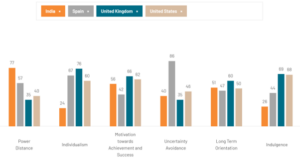
- Power Distance Index (PDI)
As documented in Figure 1, a wide gap exists between India’s high score of 77 and the lower scores of the United States (40) and the United Kingdom (35). This variance manifests directly in how teams handle operational accountability. In India, offshore employees demonstrate a strong cultural propensity to automatically escalate minor auditing disagreements upward to direct managers rather than resolving them horizontally through autonomous peer-to-peer adjustments (Hofstede et al., 2010). Spain’s intermediate score of 57 indicates a moderate structural reliance on hierarchy that must be managed by the audit center.
- Individualism vs. Collectivism (IDV)
The dataset in Figure 1 highlights an extreme divergence between the hyper-individualistic United States (91) and United Kingdom (76) versus collectivist-leaning India (24). This dimension dictates task ownership; Anglo-American stakeholders approach compliance audits with an autonomous stance, taking personal responsibility for their business lines and aggressively pushing back independently (Hofstede et al., 2010). This contrasts with Indian operations, where employees seek safety in collective management consensus before committing to core process adjustments.
- Uncertainty Avoidance Index (UAI)
The internal audit function itself acts as an institutional agent of maximum Uncertainty Avoidance. Figure 1 shows that Spain possesses an exceptionally high UAI profile of 86, mirroring the audit team’s non-negotiable demand for rigid documentation and absolute procedural clarity (Hofstede et al., 2010). This structural demand frequently collides with the lower UAI profiles of the United States (46) and the United Kingdom (35), where fast-moving front offices are comfortable navigating fluid, highly adaptable business environments and view rigid verification layers as operational roadblocks.
- Motivation towards Achievement and Success (Masculinity vs. Femininity)
This dimension drives the pace and tone of conflict resolution. According to Figure 1, the United Kingdom (66) and the United States (62) lean significantly more toward a masculine orientation than Spain (42). The Anglo-American hubs prioritize speed, assertiveness, and black-and-white metrics. This performance-driven assertiveness frequently generates friction with the relationship-oriented, consensus-seeking baseline of Spain, where professional diplomacy, saving face, and establishing interpersonal rapport are deemed essential to long-term operational execution (Hofstede et al., 2010).
- Long-Term Orientation (LTO) & Indulgence (IVR)
The metrics in Figure 1 show relatively balanced mid-range long-term horizons across the UK (60), India (51), the US (50), and Spain (47). However, because the Spanish audit hub must repeatedly evaluate the exact same global nodes over multiple fiscal years, preserving long-term institutional relationships remains mandatory (Hofstede et al., 2010). Meanwhile, the stark contrast in Indulgence scores between the Anglo nodes (UK: 69, US: 68) and India (26) suggests a final deep-level divergence in workplace optimization, where rigid constraint models clash with a preference for more dynamic, optimistic workspace interaction styles.
Outcome
To mitigate these systemic cross-cultural delays, the global financial institution deployed a dual-layered communication strategy explicitly designed to manage deep-level cultural differences by standardizing surface-level professional interactions:
- Insights Discovery Framework: The bank implemented a color-coded psychological and behavioral profiling mechanism to give teams an objective, non-judgmental vocabulary. This framework acts as a surface-level tool to help professionals quickly read and adapt to the deeper cultural and personality drivers of their global counterparts:
- Cool Blue: Analytical, precise, objective (highly concentrated within the Spanish and German auditing teams).
- Fiery Red: Assertive, results-focused, direct (predominant in US and UK commercial front-offices).
- Sunshine Yellow: Dynamic, interactive, expressive.
- Earth Green: Supportive, consensus-driven, relational (prevalent in Spanish and Indian local operations).
- The KISS Principle (Keep It Simple, Stupid): To directly counter the communication breakdowns caused by high-context elaboration colliding with low-context speed requirements, the bank mandated a structural shift in digital workflows. Rather than allowing Southern European or South Asian hubs to write dense, multi-layered, highly contextualized emails, all cross-border audit requests must be structured as 4 to 5 explicit, low-context, action-oriented bullet points.
Possible solutions
By modifying visible communication channels without attempting to alter deep regional identities, this dual strategy has drastically reduced systemic cultural noise (Weaver, 2016). Enforcing low-context clarity over digital channels has successfully limited the tendency of high-context nodes to obscure negative operational realities (Hall, 1976). Consequently, cross-border audit turnaround times have been optimized, email back-and-forth cycles between Spain and India have dropped significantly, and high-stakes compliance disputes between Anglo front-offices and European auditors are resolved with vastly improved operational velocity.
Authors
Kilat Maaskamp (Kilat Maaskamp)
Student: International Business Amsterdam University of Applied Sciences
Block 4, Semester 2, Year 1
Linkedin url http://www.linkedin.com/in/kilat-maaskamp-4b1b13330
Marek Beneš (Marek Beneš)
Student: International Business Amsterdam University of Applied Sciences
Block 4, Semester 2, Year 1
Linkedin url https://www.linkedin.com/in/marek-bene%C5%A1-3133263b8
Oscar King Oscar King
Student: International Business Amsterdam University of Applied Sciences
Block 4, Semester 2, Year 1
Linkedin url https://www.linkedin.com/in/oscar-king5/
Arturo Abella Abadín (Arturo Abella Abadin)
Student: International Business Amsterdam University of Applied Sciences
Block 4, Semester 2, Year 1
Linkedin url https://www.linkedin.com/in/arturo-abella-abad%C3%ADn-49029b148/
Matilde Pillon (Matilde Pillon)
Student: International Business Amsterdam University of Applied Sciences
Block 4, Semester 2, Year 1
Linkedin url https://www.linkedin.com/in/matilde-pillon-5a8366328