Chapter 1: Overview
1.1 Introduction
The chosen organization is an international emergency logistics provider. The company specializes in time-critical shipments and operates across Europe, Asia, and America. Due to its international operations, the company has its employees interact with a wide range of customers and operational partners, all of whom come from diverse cultural backgrounds.
1.2 Organization Background
The logistics industry is the backbone of global trade, providing a variety of goods to customers promptly and supporting a wide range of industry functions. Due to the wide range of operations across time zones, the chosen company has offices in Asia, Europe, and America. This means the company can operate 24/7, seven days a week, and 365 days a year.
The company provides multiple services and solutions, such as Urgent Air Service, where they pick up a package from any location across the world and have it sent on the airplane within the same day as the request being made. Another service is Urgent Rail Service and Urgent Road Service, which are very similar to the urgent air option but use trains and road vehicles instead of airplanes. Spare Parts Storage and Distribution Service manages the storage and rapid distribution of critical spare and replacement parts to keep machines, vehicles, and aircraft from sitting idle. For the fast-est air options, Next Available Flight Service books a shipment onto the very next available flight, airport-to-airport; Dedicated Courier Service has a courier personally hand-carry it as accompanied baggage door-to-door; and Private Aircraft Service secures a full aircraft exclusively for a single shipment when scheduled services won’t do. Finally, the company provides two specialized life-sciences services: Specialized Medical Transport Service hand-carries life-critical, temperature-sensitive cell and gene therapy materials under strict supervision, and Sensitive Medical Materials Transport Service handles the compliant, time-critical transport of radioactive nuclear-medicine ma-terials for diagnostics and therapy by specialized courier terminals with Class 7 dangerous-goods expertise.
The client population of the chosen company ranges from medical organizations wanting to transport valuable organic matter to a luxury automotive manufacturer, who is willing to pay a premium to prevent any supply chain disruption due to missing parts. As the provided logistics are quite com-plex and provide a high amount of value, the company can charge a premium rate for its services.
1.3 Purpose of the Case Study
Within this case study, we aim to better understand how culture influences communication, decision-making, and leadership within the scope of an international organization, and how an organization can best communicate across cultures.
Chapter 2: Cultural Limitations and Communication Challenges
2.1 Hierarchy and Communication
One of the most significant intercultural challenges identified during the interview was the influence of hierarchy on communication. The interviewee explained that employees in some Asian offices are often reluctant to ask for help, admit uncertainty, or escalate problems to their supervisors. Accord-ing to the interviewee, employees may fear negative consequences or feel uncomfortable admitting that they do not know how to handle a situation. As a result, they tend to follow procedures strictly and wait for instructions rather than taking independent action when problems arise.
This behaviour suggests that cultural expectations regarding authority influence communication pat-terns within the organization. In some cultures, questioning a superior or openly admitting uncertain-ty may be perceived negatively, which can discourage employees from communicating potential problems at an early stage.
The impact of this challenge is particularly significant in the emergency logistics industry, where speed and rapid decision-making are essential. The interviewee noted that delays in communication can result in slower responses to operational issues, increasing the risk of service disruptions and customer dissatisfaction. In an environment where every minute counts, hesitation to communicate problems can reduce operational efficiency and affect service quality (Personal communication, June 4, 2026).
2.2 Individual Autonomy and Overconfidence
Another intercultural challenge identified during the interview relates to differences in employee au-tonomy and decision-making. The interviewee explained that employees in the United States often take initiative and attempt to solve problems independently. While this approach can increase flexi-bility and encourage proactive behaviour, it may also lead employees to modify procedures without consulting headquarters or obtaining approval.
This behaviour suggests that cultural values may influence how employees balance independence and organizational control. Employees who are encouraged to take initiative may feel confident adapting existing procedures to local circumstances. However, when these adaptations are not communicated to other offices, inconsistencies can emerge across the organization.
The interview revealed that such behaviour can create operational difficulties in a global company that relies on standardized procedures. The interviewee explained that local adaptations to Standard Operating Procedures (SOPs) sometimes create confusion when other offices must take over op-erations or collaborate on shipments. Consequently, excessive autonomy can reduce process con-sistency and increase the likelihood of operational errors (Personal communication, June 4, 2026).
2.3 Language and Interpretation Barriers
Language and communication differences also represent an important intercultural challenge within the organization. Although English serves as the company’s primary working language, employees come from a wide range of national and linguistic backgrounds. The interviewee acknowledged that communication difficulties sometimes arise because employees use different expressions, commu-nication styles, or interpretations of the same message.
According to Weaver’s communication model, communication noise occurs when a message is dis-torted during transmission. In multicultural environments, semantic noise may occur when individu-als interpret the same information differently because of language differences or cultural assump-tions. This can affect the accuracy and effectiveness of communication (Weaver, 2013).
The interviewee also described difficulties when communicating with courier partners in China who do not speak English. Since the company operates twenty-four hours a day across multiple regions, employees often need to coordinate internationally outside local working hours. Language barriers can therefore complicate communication regarding shipment details, pick-up locations, and delivery requirements (Personal communication, June 4, 2026).
2.4 Time Perception Differences
The interview further revealed that differing perceptions of time create challenges within the organi-zation. The logistic company operates in an industry where customers expect responses within minutes and where shipment collection often needs to occur within thirty to forty-five minutes after a booking is made. Despite these operational requirements, employees from different cultural back-grounds may interpret deadlines and urgency differently.
The interviewee explained that employees may have different expectations regarding punctuality and response times. The interviewee suggested that German employees generally interpret deadlines very strictly, whereas employees from other regions may view deadlines more flexibly depending on circumstances. This illustrates how cultural perceptions of time can influence workplace behaviour and decision-making.
The impact of these differences is particularly important in emergency logistics. When employees interpret deadlines differently, coordination between international offices becomes more difficult. Delays in responding to customer requests, communicating updates, or completing operational tasks may affect service quality and reduce organizational efficiency. Therefore, differing perceptions of time represent a significant intercultural challenge for a company that relies on speed and respon-siveness (Personal communication, June 4, 2026).
Chapter 3: Hofstede Cultural Dimensions
Hofstede’s cultural dimensions explain how national cultures differ in aspects such as hierarchy, independence, uncertainty avoidance, and communication expectations (Hofstede, n.d). This frame-work is relevant because the chosen company operates across global hubs where cultural differ-ences can influence decision-making, alignment, and escalation.
1. Power Distance Index (PDI)
Power distance can strongly influence the decision-making within this company because some re-gional teams may be less. Comfortable challenging authority, admitting uncertainty, or escalating issues quickly. In high power distance cultures, employees may prefer to wait for instructions from their upper managers, follow procedures strictly, and avoid admitting they do not know something, if they fear negative consequences. In an emergency logistics environment, this can slow down the decision-making and create operational risks.
However, in lower power distance cultures, such as the Netherlands, employees may feel more con-fident speaking up, questioning authority, or contacting seniors directly. This can help faster prob-lem-solving but could create inconsistency if people act without alignment. Therefore, decision pro-cesses need a balance: clear authority and procedures, WITH a safe environment, this is being sup-ported by the company’s internal managers and through their trainings.
2. Individualism vs. Collectivism (IDV)
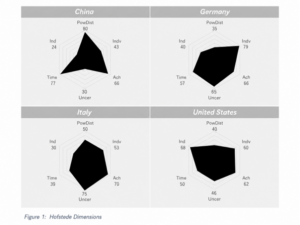
Individualism vs collectivism helps explain whether employees act mainly from personal responsibil-ity and autonomy or group loyalty and harmony. This is relevant as the company has employees from all over the world, including German, Italian, and other European teams, where decision-making styles may be different. Germany and Belgium score highly on individualism, while Italy also leans individualistic but can be more relationship-oriented in practice (The Factor Group, n.d). in urgent logistics, individual initiative is beneficial, but could become risky if employees act independently from shared procedures. The missing shipment case shows this clearly: the issue was resolved through a crisis team, specialist involvement, and updating the client regularly, suggesting that ef-fective decision-making requires individual responsibility mixed with structured collective coordina-tion.
3. Uncertainty Avoidance Index (UAI)
Uncertainty avoidance is relevant because the company is German-based and operates across time-critical hubs such as Frankfurt, Amsterdam, Munich, Vienna, Miami, Shanghai, Singapore, and more. Germany scores relatively high on uncertainty avoidance (with an average of 65), meaning decisions are often supported by throughout planning, expertise, and organized processes, but it also can create tensions across hubs: in Asian offices, employees may follow procedures very strictly and hesitate to escalate uncertainty, while in the US, employees may act too independently, as the uncertainty avoidance is much lower (with a score of 46). Critically, the company should not only standardize procedures, but also define clear escalation signals so that uncertainty is solved quickly and efficiently.
4. Masculinity vs Femininity (MAS)
Masculinity vs femininity reflects whether a culture prioritizes achievement, performance, and re-sults, or cooperation and quality of relationships. The company operates in time-critical, high-performance logistics, where speed and reliability are central to their service model. A more mascu-line approach can support urgency, accountability, and fast action, but could also increase pressure or conflict during stressful handovers. The company manager mentioned that stress can turn into anger or tension between colleagues and clients when issues arise, and urgent action is needed. Therefore, emotional escalation or blame should be prohibitive, while asking for support during challenges should not feel inhibitive to employees or clients. The crisis team example shows a good balance: performance stayed important, but the problem was solved through coordination and structured communication.
5. Long-term Orientation vs. Short-term orientation (LTO)
Long-term vs short-term orientation affects whether decisions mainly focus on immediate results or on sustainable methods, learning, and future consistency. For the selected company, this plays a relevant role because the organization promises time-critical, high performance logistics and offers 24/7 expert support for urgent shipments. The interview shows a long-term orientation through their global SOP training, version-controlled documentation, mandatory review sessions, and centralized storage, which are meant to prevent any errors between global hubs.
The challenge is that local offices, especially the US and China, sometimes adapt SOPs without approval from Frankfurt headquarters, creating dangerous divergence. When Frankfurt covers an-other region around the clock, undocumented local processes can cause errors. This shows a criti-cal tension: local adaptations should not be prohibitive, because each hub faces their own cultural and operational challenges, but undocumented adaptation should be prohibitive because it breaks global alignment. At the same time, asking for clarification or admitting that a local process is un-clear should not feel inhibitive, especially in Asian hubs where hierarchy and indirect communica-tion may already delay escalation.
In addition, the language barrier with Chinese courier partners also show that short-term solutions, such as booking using Chinese-speaking intermediaries are useful but not sufficient long-term.
The company addresses these issues by using strong local leadership as a bridge between local flexibility and head-office alignment. Critically, this approach allows the company to stay responsive across cultures while protecting long-term consistency, shared understanding, and operational safe-ty worldwide.
Figure 1. Hofstede dimensions comparison. Adapted from The Culture Factor Group (n.d.).
Chapter 4: Best Practice Example
A strong practice example from the interview is the organization’s response to a missing ship-ment crisis. The interview participant described a situation from his time as Head of Opera-tions in Western Europe, when a shipment went missing during a time critical logistic process. The employee responsible for the booking already knew the shipment was missing but did not immediately escalate this to the customer. Instead, he contacted the different partners, who took the situation rather lightly and said they would give an update once the shipment was found. At first, the problem looked operational, but it quickly became a communication issue because the customer was waiting without clear information.
The situation became more serious when the customer asked whether the shipment had ar-rived at its destination, which was believed to be in Italy. The operational employee was afraid to say that the company did not know where the shipment was. Eventually, the issue reached the team leader, who told the customer that the shipment was lost. This created more stress because the customer suddenly received bad news without enough context or reassurance. The customer then contacted the interview participant directly and asked what was happening inside the operation.
The positive solution started when the participant created calmness and structure. He told the customer he would investigate and call back within 30 minutes. Internally, he organized a cri-sis team with the team leader and the person responsible for the booking. The team had to contact the relevant operational parties and check the situation every 15 minutes. When there was a sign that the shipment might be in Brussels, the participant called the cargo manager there and asked him to return to the operation, even though he was already on his way home. This shows the organization’s deeds as well as its words. The company did not only say the shipment mattered, but it also demonstrated this through coordination, responsibility and fast follow ups.
A key part of the solution was the shift in customer communication. Instead of leaving the cus-tomer with uncertainty, the participant asked whether the customer wanted updates every 30 minutes. After several updates, the customer felt reassured because he could see that the organization was actively searching for the shipment. Eventually, the shipment was located during the night. It had been stored somewhere by mistake by a handling agent and was sent directly back to Italy. Although the customer was still unhappy and the case became a claim, he appreciated that the organization moved from almost no communication to regular commu-nication focused on the customer.
From an ethnographic perspective, this example shows people in their cultural work setting. The interview described an emergency logistics environment where time, pressure and re-sponsibility shape daily behavior, especially because every minute can matter during a disrup-tion. The explicit side of the solution was visible in the crisis team, phone calls, 15-minute in-ternal checks and 30-minute customer updates. The implicit side can be understood through Weaver’s iceberg model, which explains that visible behavior is shaped by deeper hidden as-sumptions, values and expectations (Weaver, 2013). In this case, regular updates did more than share information. They symbolized reliability, respect and control because the customer felt reassured when communication became regular and structured. The regular 15-minute checks and 30-minute customer updates became a shared routine that signaled accountability and commitment to both the customer and the operational team. What was not said was just as important. The employee’s fear of admitting “we do not know where the shipment is” shows how silence can become part of the problem. (Personal communication, June 4, 2026).
The hesitation to admit uncertainty reflects Hofstede’s idea that cultures differ in how people deal with hierarchy and responsibility, which can influence whether employees feel comforta-ble escalating problems and admitting mistakes (Hofstede et al., 2002). Weaver (2013) also helps explain the deeper communication layer, because the problem was not only what was said, but also what remained unsaid. In this case, the best practice was not only recovering the shipment but creating a shared communication routine that helped the organization move from uncertainty to action and helped the customer feel secure again. Other international or-ganizations can learn from this by preparing clear escalation procedures and by asking cus-tomers how often they want updates during disruption. Overall, this case shows how struc-tured and honest communication can turn a serious operational problem into a positive inter-cultural solution.
Chapter 5: Outcome
The main outcome of the interview is that intercultural communication in the selected organization is not only a human resources topic, but an operational necessity. Because the organization works in time-critical logistics, communication has a direct influence on speed, reliability, customer trust, and service quality. The interview showed that cultural differences do not always appear as open con-flict. In many cases, they appear through silence, hesitation, overconfidence, different interpreta-tions of time, or different expectations about hierarchy and responsibility.
One important outcome is that the organization already recognizes communication as a key opera-tional challenge. The interview participant explained that communication problems are not mainly caused by vocabulary or English language ability, but by cultural expectations around action, escala-tion, and responsibility. For example, employees in some Asian offices may hesitate to ask for help or admit uncertainty because this could feel uncomfortable in a hierarchical environment. As a re-sult, they may wait for instructions instead of taking immediate action. In contrast, employees in some North American contexts may act too independently and adapt procedures without first align-ing with head office. This creates a different kind of risk, because local initiative can become opera-tional inconsistency.
This shows that the same organizational value, such as responsibility, can be interpreted differently across cultures. In one cultural context, responsibility may mean following the procedure carefully and waiting for a superior’s decision. In another context, responsibility may mean taking initiative and solving the problem independently. The outcome is that the organization needs a shared com-munication framework that makes escalation, clarification, and decision-making acceptable across cultures.
The missing shipment example also showed that communication can change the outcome of a cri-sis. At first, the employee responsible for the booking did not communicate clearly with the customer because he was afraid to say that the shipment could not be located. This silence increased uncer-tainty and made the customer feel insecure. Once the interview participant created a crisis team and introduced regular updates, the customer became more reassured, even though the shipment was still missing. This demonstrates that in urgent situations, customers do not only need a solution. They also need evidence that the organization is actively taking responsibility.
From an intercultural perspective, the outcome of the case is that structured communication can reduce uncertainty. The internal checks and regular customer updates created a shared rhythm. This helped the team move from confusion to action, while also helping the customer feel included in the process. According to Weaver’s iceberg model, the visible behaviour was the regular phone calls and follow-ups, but the deeper hidden value was reliability, respect, and control (Weaver, 2013). Therefore, the best practice was not only recovering the shipment but also creating a communication routine that made responsibility visible.
Another outcome is that fairness within the organization is still inconsistent. The interview participant explained that fairness depends strongly on the management style of each leader. Some managers are supportive and open, while others are more controlling or strict. This can create different em-ployee experiences depending on the department or region. From the interview, it became clear that fairness is not only about treating everyone the same, but about giving employees clear expecta-tions, feedback, support, and the opportunity to speak up.
Overall, the case shows that the organization has strong operational knowledge and a global net-work, but its intercultural communication still depends heavily on leadership, documentation, and individual judgment. The organization has already developed useful practices, such as SOPs, crisis teams, quality management, speak-up channels, and local leadership. However, the interview also showed that these tools need to be applied more consistently across regions. The final outcome is that intercultural communication should be treated as part of operational risk management, because misunderstandings, silence, and unclear escalation can directly affect time-critical logistics perfor-mance.
Chapter 6: Possible Solutions
Based on the interview, the most important solution for the organization is to create clearer and more culturally sensitive escalation procedures. In time-critical logistics, employees cannot wait too long before communicating uncertainty, because every minute can affect the customer and the shipment. However, the interview showed that employees from some cultural backgrounds may feel uncomfortable admitting that they do not know something or that a problem has occurred. Therefore, escalation should not be presented as a failure, but as a normal and expected part of responsible operational behaviour.
One possible solution is to create a global escalation guide with clear trigger points. For example, if a shipment cannot be located after a specific number of minutes, if a partner does not respond, or if a customer asks for information that the employee cannot confirm, the employee should immediately escalate the issue to a team leader or crisis contact. This would reduce uncertainty because em-ployees would not need to personally decide whether escalation is appropriate. Instead, they could follow a shared rule. This is especially useful in high power distance or high uncertainty avoidance cultures, where employees may prefer clear instructions before taking action (Hofstede et al., n.d.).
A second solution is to improve SOP alignment between head office and local offices. The interview participant explained that some local offices adapt Standard Operating Procedures without approval from head office. This can create serious problems when another hub needs to take over an opera-tion, because undocumented local processes are not visible to the rest of the company. To solve this, the organization could introduce a local adaptation request process. Local teams would still be allowed to suggest changes, but these changes would need to be documented, reviewed, and stored centrally. This would protect local flexibility while also maintaining global consistency.
A third solution is to make communication expectations more explicit during training. Instead of only training employees on operational steps, the organization could include intercultural communication scenarios in its onboarding and yearly training. For example, employees could practice how to say, “I do not know yet, but I am checking,” or “This issue needs escalation,” in a way that feels profes-sional and safe. This would help reduce the fear of admitting uncertainty. It would also show that asking for support is not a weakness, but a way to protect the customer, the team, and the ship-ment.
A fourth solution is to standardize crisis communication with customers. The missing shipment case showed that the customer became calmer once regular updates were provided. Therefore, the or-ganization could create a customer communication protocol for disruptions. When a serious issue occurs, the employee or team leader could ask the customer how often they would like updates, for example every 30 minutes or every hour. This would allow the company to adapt to different cus-tomer expectations while still keeping communication structured. It would also prevent silence, which can easily damage trust during urgent situations.
A fifth solution is to strengthen leadership training. The interview participant explained that fairness in the organization depends heavily on the manager, and that some managers are supportive while others can be controlling or difficult to work with. This suggests that leadership culture is not yet fully consistent. The organization could introduce mandatory intercultural leadership training for team leaders and managers. This training should focus on psychological safety, fairness, feedback, con-flict management, and cultural differences in communication. Managers should learn how to create an environment where employees feel safe to ask questions, admit mistakes, and escalate problems early.
A sixth solution is to use local cultural bridges more intentionally. Since the organization operates across several international regions, local leaders can help translate not only language, but also expectations. This would reduce the risk of misunderstanding between head office and regional teams.
Finally, the organization could develop a simple post-crisis reflection process. After a shipment dis-ruption, the team could briefly review what happened, what was communicated, what remained un-clear, and what should be improved. This should not be used to blame employees, but to learn from the situation. Over time, these reflections could help the organization identify repeated intercultural communication patterns, such as hesitation to escalate, over-independent local action, unclear time expectations, or language barriers with partners.
Overall, the strongest solution is not to remove cultural differences, but to create systems that help employees work across them. Clear escalation triggers, documented SOP adaptations, structured customer updates, intercultural training, stronger leadership development, and post-crisis reflection would help reduce misunderstandings and improve operational reliability. In this way, intercultural communication becomes part of the organization’s quality management and not only a soft skill.
Authors
Jessica Petryk.(www.linkedin.com/in/jessica-petryk-966070232 )
Student: International Business Amsterdam University of Applied Sciences
Block 4, Semester 2, Year 3
Gabriela Mozes (www.linkedin.com/in/gabriela-mozes-3058681a2)
Student: International Business Amsterdam University of Applied Sciences
Block 4, Semester 2, Year 3
Kiran Bahorie (https://www.linkedin.com/in/kiran-bahorie-4b928934b)
Student: International Business Amsterdam University of Applied Sciences
Block 4, Semester 2, Year 3
Louis Olivares (https://www.linkedin.com/in/louisolivares/)
Student: International Business Amsterdam University of Applied Sciences
Block 4, Semester 2, Year 3
Sofiia Chycha (linkedin.com/in/sofiia-chycha-6a55263a0)
Student: International Business Amsterdam University of Applied Sciences
Block 4, Semester 2, Year 3