Overview
In today’s connected global market, working effectively across cultures is not just a soft skill but a strategic necessity. This paper examines the daily friction inside a leading multinational technology conglomerate, focusing on how its Western Euro-pean regional subsidiary navigates its relationship with an East Asian global head-quarters.
The central tension is a stark contrast in working styles, and it is a contrast with real operational consequences. The regional workforce defaults to an explicit, low-context communication style, prioritizing structural efficiency, speed, and direct dia-logue. Global leadership, by contrast, operates within a high-context, hierarchical culture, where preserving harmony, reading between the lines, and following top-down directives take precedence over speed. These are not simply different prefer-ences; they actively shape how decisions get made, how feedback travels through the organization, and how much unseen effort employees put into managing the gap between the two.
Through an in-depth interview with a marketing trainee at the regional subsidiary, this case study examines how these opposing cultural foundations create friction in practice, and, more importantly, what that friction costs the organization. Beyond describing how communication styles differ, this paper looks at the strategic and human cost of that difference: the extra administrative labor required to soften direct messages, the risk that hierarchical buffering suppresses valuable feedback before it reaches senior leadership, and the trade-offs between speed and stability that emerge from each culture’s default approach. By examining daily interactions such as budget discussions, work-life balance expectations, and the pace of communica-tion, this paper argues that bridging this divide requires more than awareness of cul-tural difference — it requires organizations to confront the specific inefficiencies and emotional labour that difference generates.
Hofstede Dimensions
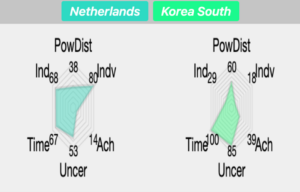
The friction between the regional subsidiary and the global headquarters can be sys-tematically analyzed through Hofstede’s Cultural Dimensions. The divergence be-tween these two cultures across multiple dimensions fundamentally explains the root causes of their operational and communication challenges.
The most significant point of friction manifests in Power Distance (PDI). The regional subsidiary operates within a low Power Distance culture characterized by a flat or-ganizational structure, a strong valuation of consensus, and an environment where employees routinely engage in open dialogue with managers regarding the feasibility of targets. Conversely, the global headquarters operates on a rigid high Power Dis-tance model. As noted by an internal source, “higher management consists exclu-sively of leadership from the headquarters, meaning all critical decision-making pow-er is concentrated at the very top.” This centralized authority demands strict compli-ance and a performative, formal respect, creating a stark contrast to the regional office’s consensus-based structure. Consequently, when senior management from global HQ mandates a strategy, it is rarely challenged, even if it contradicts local market realities. While regional middle management attempts to act as a “cultural translator” to ensure local teams achieve targets without appearing insubordinate, this buffer role ultimately stifles innovation. By heavily filtering upward communica-tion to preserve the hierarchy, middle management inadvertently prevents critical, diverse feedback and local market insights from reaching global decision-makers.
This structural tension is further exacerbated by contrasting approaches to Uncer-tainty Avoidance (UAI), Masculinity (MAS), and Individualism (IDV). Global leader-ship displays characteristics of high Uncertainty Avoidance by emphasizing clear re-sponse expectations, strict KPI targets, and rapid communication to mitigate ambi-guity. For example, the expectation of immediate email responses—where delays are viewed negatively—illustrates a rigid control mechanism. These performance expectations also reflect high Masculinity (MAS), emphasizing success, competition, and measurable achievements. The practice of continuously comparing regional subsidiaries and heavily scrutinizing underperforming markets highlights this compet-itive drive.
In stark contrast, the Dutch subsidiary demonstrates a highly individualistic (IDV) culture. Employees value independence, openly express dissenting opinions, and prioritize a healthy work-life balance. This fundamentally clashes with the collectivist culture at headquarters, which prioritizes organizational harmony, teamwork, and unwavering dedication to the company above individual autonomy.
Finally, these cultural disparities directly impact strategic decision-making and Long-Term Orientation (LTO). Interestingly, the interview reveals that Long-Term Orienta-tion varies significantly even within different departments of the regional subsidiary. The sales department, for instance, operates with an extreme short-term focus, evaluating results on a weekly basis and rapidly discarding strategies that fail to de-liver immediate growth. Conversely, the marketing department is afforded the flexi-bility to focus on long-term brand building. Viewed comprehensively through Hof-stede’s framework, the systemic challenges between the regional subsidiary and the global headquarters are not merely isolated misunderstandings, but the predictable outcomes of fundamentally misaligned values in Power Distance, Individualism, Un-certainty Avoidance, Masculinity, and Long-Term Orientation.
However, these cultural differences should not only be viewed as sources of conflict. During periods of organisational uncertainty or crisis, the hierarchical structure at the global headquarters can provide stability, consistency, and faster implementation of strategic decisions across global markets. Likewise, the Dutch subsidiary’s prefer-ence for consensus encourages employee participation and the sharing of ideas but may also slow decision-making when immediate action is required. This suggests that neither cultural approach is inherently superior. Instead, their effectiveness de-pends on the organisational context and the ability of both sides to adapt to one an-other.
Figure 1: Hofstedes Dimenssions
Outcome
The work culture within this multinational conglomerate is really a mix of two very different cultural approaches. When the Western European regional subsidiary works together with the East Asian global headquarters, this mix leads to clear cul-tural limitations in how people behave on the work floor, and, more importantly, to real operational costs that are easy to overlook if you only look at the surface-level clash. Using Weaver’s Communication Theory, we can break these limitations down into two categories: inhibitive and prohibitive behavior, each linked to a different kind of cultural difference. The interview with our interviewee, a marketing trainee at the regional subsidiary, provides evidence base for both categories and shows how these differences play out in daily practice, not just in theory.
The regional team communicates in a low-context style, meaning things are said directly and clearly instead of being implied. According to Weaver’s theory, this di-rectness isn’t just a personal habit; it’s simply how low-context communication works: things need to be said out loud and confirmed, because you can’t rely on people picking up on hints. Our interviewee illustrated this clearly, explaining that if something is bothering an employee, they will simply walk up to a colleague’s desk and say, “okay, let’s solve this right now.” This direct, face-to-face problem-solving works fine within the regional office, but it becomes a problem (inhibitive behavior) when interacting with the global headquarters. The East Asian HQ works in a high-context style, where meaning is often read between the lines, tone and hierarchy matter a lot, and keeping group harmony is a top priority. Because of this, the direct and fast approach from the regional team doesn’t just seem unfamiliar to them, it can genuinely come across as blunt, rude, or even aggressive, which makes it hard-er to keep things comfortable and harmonious the way the global side expects.
This friction does not stay theoretical; it shows up as extra, unpaid labor, and our interviewee’s own account of her work routine is the clearest evidence of this. She described routinely verifying her emails with colleagues before sending them to the global headquarters, checking that the tone was soft enough and the phrasing indi-rect enough before anything went out. On paper, this looks like a small, harmless step. Taken as a data point rather than an anecdote, though, it means that every message crossing the cultural divide requires a second round of work: writing the message, then re-writing it, then having it checked by someone else, to survive a different cultural filter. What she described as “communication being different” is, in practice, communication becoming more expensive, since time that could go toward the actual task instead goes toward managing how the task will be perceived. This is not just an efficiency problem either, it is an emotional one: constantly monitoring your own tone to avoid being read as blunt or disrespectful requires a kind of vigi-lance that culturally homogenous teams simply do not need, and over time this steady self-editing adds up to a form of emotional labor that her account suggests is never formally named or accounted for in how employees’ workload is assessed.
Another example of inhibitive behavior that came directly out of the interview is the speed at which people are expected to communicate. Our interviewee noted that the global HQ expects replies almost immediately, and that waiting a week to respond to an email is seen in a negative light. Since speed itself carries meaning in a high-context culture, being slow can look like you don’t care or aren’t taking things seri-ously. This creates friction with the regional team’s slower, more relaxed pace, even though, as she was careful to point out, there is no bad intention behind it. Read to-gether, her comments on tone-checking and response speed point to the same un-derlying issue: the regional team is not just working but constantly managing how their working style is perceived by the other side.
The massive difference in how both cultures view power dynamics leads straight to prohibitive behavior, and again, our interviewee’s account supplies the concrete evi-dence. Over in the European office, the organizational structure is very flat, and it is completely normal to talk casually with your manager. As she mentioned, regional employees feel very comfortable speaking up or sharing their own opinions if they disagree with their local manager. On the flip side, the global headquarters maintains a very strict, top-down hierarchy; she noted that new employees are already explicit-ly warned during their job interviews that it is a very hierarchical company, which sig-nals just how central this expectation is to the organization’s culture from day one.
Over there, showing absolute respect for senior management is a basic, unbreaka-ble rule. Being too relaxed or jovial with higher-ups, which she described as standard practice in the regional office, is seen as prohibitive behavior by global leadership. Openly disrespecting the strict management structure goes completely against their core cultural values. She gave a specific example: when a senior business manager from the global headquarters dictates that a certain strategy must be executed, al-most nobody dares to go against it, because the decision comes straight from the top.
Because of these huge differences, the teams are constantly forced to find a middle ground, and much of that middle ground is currently held together by middle man-agement acting as an informal cultural buffer, softening messages, timing communi-cations carefully, and shielding the regional team from being read as disrespectful. But this buffer solves the symptoms, not the source. It allows the organization to keep functioning day to day, while leaving the underlying mismatch between low-context and high-context expectations completely intact. Our interviewee’s account of budget negotiations is a clear data point for where this buffer breaks down: the global headquarters often demands more revenue and tells the regional subsidiary that they have to hit all their Key Performance Indicators (KPIs) and show growth, but somehow with less budget. According to her, the regional team pushes back, arguing that it is practically impossible to achieve that without the budget going up, but the final choices from the global HQ are usually still leading, even when it is not necessarily the smartest choice for the local market. This is arguably the buffer fail-ing in real time: the same manual translation and softening that smooths over day-to-day communication cannot fully absorb a direct disagreement over resources, and the regional team’s practical objections still get overridden.
Put together, these examples, all grounded in our interviewee’s own account rather than general assumptions about cultural difference, show that the friction here isn’t just random misunderstanding. It’s the predictable result of two cultures that each make total sense internally, but clash when they meet, and the current coping mechanism, informal buffering middle management, treats the symptoms without addressing the root mismatch. Every new hire, every new project, and every new email still needs the same manual translation, because the system itself has not changed, only the workaround around it. Once you separate the inhibitive issues (communication style and speed) from the prohibitive ones (challenging hierarchy and authority) and use the interview to trace the ongoing cost of managing both, it becomes much easier to see not just where the friction comes from, but why relying on individual employees to quietly absorb it is not a sustainable long-term solution.
Possible solutions
Based on what came up in the interview, there are a few best practices that could help the company bring these two working styles closer together and close the gap between the regional and global teams.
Enhanced facilitation for global meetings: The company already uses culturally fluent facilitators to keep messaging consistent and avoid language-related confusion dur-ing international meetings. For example, marketing presentations meant for regional markets are often given by presenters with fluent American English, which helps get the message across clearly across different regions. This approach reduces misun-derstandings and allows employees from different regions to focus more on the con-tent of discussions rather than language barriers.
Diplomatic communication integration: Regional management acts as a kind of buff-er between junior regional staff and senior global leadership. As mentioned in the interview, direct cultural clashes rarely happen between these two groups because regional managers translate the direct, low-context concerns from the regional side, such as KPIs and budget discussions, into the more harmony-focused communica-tion style expected by headquarters. This helps prevent unnecessary conflict and keeps communication running smoothly. However, this solution does not fully solve the problem. Because managers do most of the translating, employees have fewer opportunities to develop their own intercultural communication skills. Over time, this can make the company too dependent on a small group of people to bridge cultural differences instead of helping everyone communicate more effectively across cul-tures.
Cross-cultural competency development: The company already provides new em-ployees with one intercultural training session during onboarding, but the interview shows that communication challenges continue long after that. For example, em-ployees often think carefully about how emails will be interpreted before sending them to headquarters. While this helps avoid misunderstandings, it also takes extra time and effort that could otherwise be spent on productive work. Offering regular intercultural workshops throughout the year, focusing on communication styles, hier-archy, feedback, and decision-making, would help employees become more confi-dent in working with colleagues from different cultural backgrounds. Instead of learn-ing about these differences only once, employees would continue developing the skills needed to communicate more effectively and collaborate across cultures.
These recommendations focus on solving the cause of communication challenges instead of only reducing their effects. While the current approach helps avoid conflict in the short term, helping employees develop stronger intercultural communication skills would improve collaboration, support better decision-making, and strengthen the relationship between the regional subsidiary and the global headquarters.
Authors
Sude Korca (Sude Korca)
Student: Sude Korca , AMSIB, Amsterdam University of Applied Sciences
Block 4, Semester 2, 2026
https://www.linkedin.com/in/sudekorca/
Tishana Bertad (Tishana Bertad)
Student: Tishana Bertad , AMSIB, Amsterdam University of Applied Sciences
Block 4, Semester 2, 2026
https://www.linkedin.com/in/tishana-bertad-1a9794387/
Lawa Gurgy (Lawa Gurgy)
Student: Lawa Gurgy , AMSIB, Amsterdam University of Applied Siences
Block 4, Semester 2, 2026
www.linkedin.com/in/lawa-gurgy-4b119b218
Biography/references
Anonymous. (2026). Interview transcript – Intercultural communication within a global technology conglomerate[Transcript of interview conducted 17 June 2026].
Google. (2026). Gemini (Large language model). https://gemini.google.com/
Hofstede, G. J., Pedersen, P. B., & Hofstede, G. (2002). Exploring cultures: Exercises, sto-ries, and synthetic cultures. Intercultural Press.
iStock. (2021). Moderne zaken jonge gerichte ernstige bedrijfsvrouwen en mannen die in een vergadering werken [Stock photograph]. https://www.istockphoto.com/nl/foto/moderne-zaken-jonge-gerichte-ernstige-bedrijfsvrouwen-en-mannen-die-in-een-gm1313265074-401812457
Weaver, G. (2013). Intercultural relations: Communication, identity, and conflict. Pearson Learning Solutions.
Acknowledgments
The authors acknowledge the use of Google Gemini (June 2026 version) for text editing, paraphras-ing, and improving the grammatical and professional tone of this manuscript. The final content was reviewed, edited, and approved by the authors, who take full responsibility for the integrity of the work.