Overview
The company in this case is an international retail organisation operating in a multicultural workplace environment. The interviewee is a store manager in a Western European branch, where employees and customers come from different national, cultural, and linguistic backgrounds.
Although diversity is a normal part of the workplace, the interview shows that cultural differences between employees of diverse backgrounds can still create misunderstandings, discomfort, and hesitation in daily work. These limitations are most visible in the different communication styles among employees, especially in feedback and in how behaviour is interpreted. What feels clear and supportive to one employee may feel too direct or critical to another.
At the same time, the interviewee describes the organisation as one that values fairness, inclusion, and belonging. Employees are expected to feel respected and supported regardless of their back-ground, and the workplace aims to create an environment where people can communicate openly and work together effectively. This case, therefore, shows both the challenges and the value of in-tercultural communication in an international retail setting.
Hofstede Dimensions
Geert Hofstede’s model helps interpret the cultural dynamics in the interview. Although the inter-viewee is originally from Turkiye, the focus here is on the organization itself, which originates in Canada and operates a store in the Netherlands. Figure 1, therefore, compares the company’s home culture (Canada) with the host culture (the Netherlands), after which each dimension is read through what the interviewee said. All quotations come from the interview of 17 June 2026.
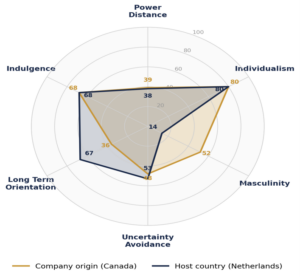
Figure 1: Hofstede Dimensions. Company origin (Canada) versus host country (Netherlands)
Power Distance (Canada 39, Netherlands 38)
Canada and the Netherlands both score low and almost identically, so the company’s direct and consultative style of communication transfers easily to the Dutch store. Feedback runs in every direction, which the interviewee called “something like 360 degrees between the hierarchy” (inter-view, 17 June 2026), and he described decision-making as “collaborative”, with staff encouraged to “share ideas and take ownership”. For decision-making processes, employees are expected to con-tribute rather than wait for instructions.
Individualism versus Collectivism (Canada 80, Netherlands 80)
Both cultures are highly individualistic and score the same, valuing independence and personal voice. The store reflects this in encouraging “greater autonomy and flexibility” and individual owner-ship, yet it also builds team unity, with the interviewee describing a team that is “collaborative, sup-porting each other with tasks very well” and hiring for “a really good fit with the company’s culture”. For decision processes, individual voice is respected while group harmony is actively protected.
Uncertainty Avoidance (Canada 48, Netherlands 53)
Both countries score within the moderate range, comfortable with some ambiguity but supported by structure. The store uses a dedicated training program, referred to as the ERTP, or Employee Retail Training Program, where clear expectations for employees are introduced in a standardized manner, as well as training for IDEA (Inclusion, Diversity, Equity and Action) between employees. An em-ployee check-in is done before every shift, where Key Leaders explain the tasks and goals of the day, as well as ask if anything is on an employee’s mind to clear before starting the shift, to reduce miscommunication between one another. When things fail, the interviewee stays flexible: “If we have a problem, we can solve it together”. For decision-making processes, expectations are set in ad-vance while leaders remain adaptable to the situation at hand.
Masculinity versus Femininity (Canada 52, Netherlands 14)
This is one of the two largest gaps. Canada leans towards achievement and competition, while the Netherlands is strongly feminine and cooperative. The Dutch store sits closer to the feminine end: the interviewee wants everyone to “be present” in the moment and tells employees having a harder time of day to “have a rest for 10 or 15 minutes” in the breakroom, he also points out a free “em-ployee health service” where employees are able to register for free mental health services, and calls inclusion “an everyday practice”, all while still keeping clear sales targets. For decision-making processes, well-being and fairness are weighed alongside results, blending the company’s perfor-mance focus with the caring host culture.
Long Term Orientation (Canada 36, Netherlands 67)
The second largest gap is Canada is more short-term and normative, whereas the Netherlands is more long-term and pragmatic. In the Dutch setting, the interviewee emphasizes lasting relation-ships, noting that trust grows “after working a year” and that the goal is “we want employees to come back to our store”, with feedback consistently given so small issues do not “become repeated actions”. Development in the store and guest experiences are judged by lasting value rather than a single sale.
Indulgence versus Restraint (Canada 68, Netherlands 68)
Both cultures score the same and relatively high, allowing people to enjoy work and express positive emotions. The interviewee builds in small rewards such as ordering matcha or protein shakes when the team hits a sales target because it helps employees feel recognised, and that hard work pays off, this in turn to makes the general working environment positive when colleagues seem down. For decision processes, recognition and morale are used deliberately.
Conclusion
Canada and the Netherlands align closely on power distance, individualism, uncertainty avoidance, and indulgence, which helps the company’s culture operate smoothly in the Dutch market. The clearest differences are in masculinity and long-term orientation, where the store adapts towards the more caring, relationship-focused Dutch end while keeping the company’s results focus. The inter-viewee bridges any remaining gaps by making expectations clear, inviting feedback from all direc-tions, and building “one common culture” so that a diverse team works together effectively.
Outcome
The interview shows that the store manages cultural diversity by building a shared identity rather than emphasising individual backgrounds on the shop floor. The interviewee explained that, regard-less of whether staff “come from Turkey… Malaysia, or… Argentina,” everyone is expected to follow “one company culture,” supported by “one common language” so that communication stays con-sistent across the team. In this sense, the outcome of the store’s approach is a workplace where national or ethnic background is treated as secondary to a shared professional culture, which ap-pears to support efficiency and team cohesion.
At the same time, the interview reveals that this shared culture is not absolute. Personal background re-emerges once interactions move beyond routine tasks: when “conversation or communication goes a little bit deeper with the guests,” employees are encouraged to “share something with your own background,” and the interviewee noted this can even “affect the guests’ buying decision.” This suggests that cultural identity is not erased but managed strategically: minimized in internal coordi-nation, where a single shared norm reduces friction, but reintroduced selectively in customer-facing moments, where it can add value. However, relying on one dominant language and culture to hold the team together, can still create discomfort for employees who are less confident in that shared language or whose home-culture norms (for example, around hierarchy or directness) differ more strongly from the store’s. These tensions around communication style, feedback, and fairness are the practical issues the case turns to next.
Possible solutions
A useful solution would be to make communication habits more explicit within the team. Employees and managers could check understanding more often, repeat important information when needed, and rephrase instructions in a clear and simple way. This would reduce confusion, especially in a workplace where English is the shared language but not everyone’s first language.
Another solution would be to make expectations around feedback clearer. Since direct feedback can be interpreted differently depending on cultural background, it would help if the organisation created a shared understanding of what constructive feedback looks like. This could reduce the risk of em-ployees experiencing support as criticism.
It would also be valuable for the organisation to keep supporting fairness through daily practice. Managers can do this by creating psychological safety, encouraging employees to speak up, and making sure everyone feels included. In this way, smaller inhibitive issues such as hesitation or discomfort can be addressed before they become larger misunderstandings.
Finally, the organisation could benefit from creating more space for reflection on intercultural com-munication. Since differences in language, feedback, and behaviour are part of daily work, open discussion of these differences could improve understanding and strengthen teamwork.
Authors
Quinn Purmer
Quinn Purmer – Pathé | LinkedIn
Student: Amsterdam School of International Business, Amsterdam University of Applied Sciences
Block 4, Semester 2, 2026
Zakaria Siham https://www.linkedin.com/in/zakaria-siham-a3445a390/?locale=en
Student: Amsterdam School of International Business, Amsterdam University of Applied Sciences
Block 4, Semester 2, 2026
Lois de Wit https://www.linkedin.com/in/lo%C3%AFs-de-wit-a93954381/
Student: Amsterdam School of International Business, Amsterdam University of Applied Sciences
Block 4, Semester 2, 2026
Anna van Teeseling https://www.linkedin.com/in/annavanteeseling/
Student: Amsterdam School of International Business, Amsterdam University of Applied Sciences
Block 4, Semester 2, 2026
1 remaining teammates rather stay anonymous